 ChatGPT
 Perplexity
 Claude
 Gemini
 Grok
Grok
A sand point water well, also called a sand point well, driven point well, drive point well, or well point well, is a shallow well made by driving a small diameter pipe with a screened tip into the ground until it reaches a water bearing layer, usually sand or gravel. Instead of drilling a large borehole with heavy equipment, a sandpoint well uses a driven point and a well screen to pull water from near surface groundwater.
For the right property and soil conditions, a sand point well can be a practical way to supply water for irrigation, livestock, outdoor washing, ponds, or light residential use. It is not always the best fit for full household demand, but when it is installed correctly and placed in the right geology, it can be a solid and affordable option.
Since NightOwl Monitoring focuses on smart well water monitoring and control, we look at sand point wells through a simple lens: shallow wells can be sensitive to seasonal changes, pump stress, and water level fluctuations, so visibility into system behavior helps you prevent downtime and protect your equipment.
What Is a Sand Point Well?
A sand point well is built from a narrow pipe, commonly around 1 1/4 well pipe (you will also see 2 inch sand point well kit options), with a screened intake section at the bottom. The screened section is paired with a hardened tip that helps the assembly push through soil. Once the screen reaches a water producing layer, water can enter through the slots and travel up the pipe to a pump.
You might see different terms online that refer to the same idea:
- Sand point well or sandpoint well
- Point well or point wells
- Driven point well
- Point driven well
- Drivepoint well
- Well point well
- Pipe well (sometimes used loosely)
In most cases, people are talking about a shallow point well that pulls water from sand and gravel formations using a screened point.
How Does a Sand Point Well Work?
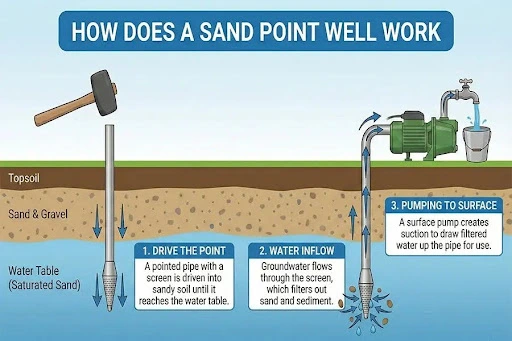
If you have ever wondered how does a sand point well work, it is basically a controlled way of tapping into shallow groundwater without drilling.
Here is the concept:
- The well point and screen are driven down into a permeable layer like sand or gravel.
- Groundwater naturally sits in the open spaces between grains in that layer.
- When your pump runs, it creates a pressure difference that pulls water toward the screen.
- Water flows through the screen openings, then up the pipe to your pump and plumbing.
A sandpoint well works best when the underground material allows water to move easily, which is why sandy soils and gravel deposits are ideal. In tight clay soils, water does not move fast enough toward the screen, so yield can be poor even if water is technically present.
Key Parts of a Sand Point Water Well System
A typical sand point well installation includes these main components:
1) The driven point (drive point)
This is the hardened tip, sometimes called the driven point or drive point, that helps the pipe penetrate the ground and protects the screen.
2) The well screen
The screen is the intake section. It has slots or mesh that let water in while helping keep sand out. Screen size matters because it affects how much sand enters the system and how easily water flows.
3) Drive pipe and couplings
The well is built with sections of threaded pipe. You drive one section, then connect the next section as you go deeper. This is where terms like well point pipe, pipe for water well, and sand point well pipe come from.
4) Pump and plumbing
A sand point well pump is often a shallow well jet pump, but pump choice depends on how deep the water level is and how far you need to move the water.
5) A protected wellhead
Even a shallow well needs protection at the top. Keeping the well sealed, capped, and protected from surface water is a big part of keeping water quality stable.
Sand Point Well Diagram, Explained Simply
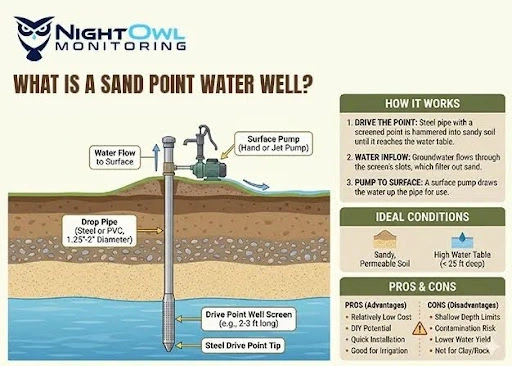
People search for a sand point well diagram because it helps visualize how everything stacks together underground. Imagine this from top to bottom:
- At the surface: the pipe comes out of the ground and connects to the pump system.
- Below grade: sections of drive pipe run downward.
- Lower section: a screened intake section.
- Bottom tip: the hardened driven point.
- Around the screen: a sand or gravel layer where groundwater can flow into the screen.
That is the basic shallow water well diagram idea. You are placing the screen where water can move freely, then pulling it upward through the pipe.
Where Sand Point Wells Work Best
A sand point well is not a universal solution. It is very dependent on soil and water table conditions.
Best conditions for a sandpoint water well
- Sand and gravel soils
- Shallow groundwater
- Areas with consistent water bearing layers near the surface
Conditions that cause trouble
- Clay heavy soils
- Rocky ground, boulders, hardpan layers
- Very deep water tables
- Highly variable seasonal groundwater levels
If driving becomes difficult or the point cannot reach a productive layer, the well may not work or may produce very low yield.
Sand Point Well Depth: What to Expect
Sand point well depth is one of the most common questions, because depth controls both feasibility and pump type.
A sandpoint well is generally considered a shallow well. In many areas, they are installed somewhere in the range of a few meters to a few dozen feet, but real depth depends on local groundwater and soil conditions.
The practical limitation is not just how deep you can drive pipe. It is also how deep your pump can reliably pull water. Many typical shallow well setups struggle once the pumping water level gets too deep. If the water level drops significantly while pumping, you can end up with low flow, pump strain, or loss of prime.
A good rule of thumb is this: a sand point well performs best when the screen is set deep enough below the normal water level so it stays submerged even during pumping drawdown.
Sand Point Well Pump Options
Choosing the right sand point well pump depends on depth, desired flow rate, and how you plan to use the water.
Shallow well jet pump
This is one of the most common choices for sand point wells. It is relatively straightforward for light residential use and outdoor water needs.
Hand pump setups
Many people buy a sand point well kit with hand pump for gardens, livestock, cabins, or backup water. These systems can be useful, but they are generally best for lower flow needs.
Higher demand systems
If you need higher volume or more stable pressure, the system design becomes more important. Pipe diameter, screen length, and pump configuration all matter. In some cases, a sand point well simply cannot deliver enough water for a high demand household.
Sand Point Well vs Drilled Well
This comparison matters because people often choose a sand point well expecting it to behave like a drilled well.
Sand point wells
- Shallow and small diameter
- Often lower yield
- More sensitive to seasonal water table shifts
- Easier and cheaper to install in ideal soils
- Can be more vulnerable to surface contamination if not properly protected
Drilled wells
- Deeper access to aquifers
- Often higher and more stable yield
- Better for full household water demand
- Typically more robust long term, depending on construction and local conditions
A sand point well can be a smart option for the right use case, especially irrigation and seasonal demand. For full home usage with multiple fixtures, many owners prefer a drilled well for capacity and reliability.
Pros and Cons of Sand Point Wells
Benefits
A sand point water well can be attractive because it is:
- Lower upfront cost in many cases
- Faster to install when soils cooperate
- Less disruptive than drilling
- A practical option for gardens, irrigation, and light water use
Drawbacks
The tradeoffs to consider:
- Lower water volume compared to many drilled wells
- Sand intrusion if screen sizing or placement is wrong
- Pump maintenance can be higher if the system draws sand
- Yield can drop seasonally as groundwater levels shift
- Water quality can be more variable in shallow groundwater zones
Cost of a Sand Point Well: What Affects Price?
People search cost of sand point well and sand point well cost because pricing can vary widely. The major cost factors are:
- Soil conditions, sandy soils are easier, rocky soils can be impossible
- Depth required to reach a productive layer
- Pipe diameter and material
- Screen type and screen length
- Pump type and pressure tank needs
- Whether you are doing a simple outdoor system or a potable water system
- Local permits, setbacks, and code requirements
If the well is for drinking water, plan on added steps for water testing, proper sanitary protection, and sometimes additional treatment equipment.
Water Quality and Safety Considerations
Shallow wells pull water closer to the surface, which can make them more sensitive to what happens above ground. That does not mean the water is automatically unsafe, but it does mean good practices matter more.
If you plan to use a sand point well for household water, it is wise to:
- Test water regularly
- Keep the wellhead sealed and protected
- Avoid installing near septic systems, livestock areas, chemical storage, or runoff zones
- Use backflow protection on hose connections
- Consider treatment if testing indicates bacteria, sediment, iron, or other issues
For non drinking uses like irrigation, water quality still matters because heavy sediment can clog sprinklers, damage pumps, and reduce system performance.
How to Install a Sand Point Well: A Practical Overview
People often search how to install sand point well or how to install a sandpoint. Installation details vary by region and local rules, so think of this as a high level overview, not a substitute for local guidance or professional support.
A typical workflow looks like this:
- Pick a safe location with proper setbacks and drainage.
- Start the well straight so the pipe does not drift as it goes down.
- Attach the well point and screened section to the first pipe.
- Drive the pipe down in sections, adding couplings as you go.
- Stop when the screen is positioned in a productive water bearing layer and deep enough to stay submerged during pumping.
- Develop the well by flushing and pumping until water runs clearer.
- Connect the pump system, pressure tank, and plumbing.
- If using for household supply, disinfect and test water before use.
If you are installing a potable system, it is worth working with a qualified well professional to avoid contamination risks and to ensure code compliance.
Maintenance Tips and Common Problems
A sand point well system tends to be simple, but it still needs attention.
Common issues
- Sand in water: screen damage, incorrect screen slot size, or placement in the wrong formation
- Low yield: screen clogging, seasonal drawdown, or not enough screen submerged during pumping
- Loss of prime: air leaks in suction plumbing, low water level, or pump setup issues
- Pressure problems: leaks, clogged filters, failing pressure tank, worn pump parts
One of the most important habits is watching for performance changes early, because shallow wells can shift quickly with seasonal conditions.
How NightOwl Monitoring Helps Sand Point and Shallow Well Systems
A sand point well is often more sensitive than a deeper drilled well. Water levels can change faster, pumps can cycle more frequently, and small leaks or restrictions can have a bigger impact.
NightOwl Monitoring supports well owners and operators by giving visibility into the things that typically cause problems in shallow systems, including:
- Water level behavior and drawdown patterns
- Pressure instability that suggests leaks, clogs, or pump stress
- Pump runtime and cycling trends that can point to inefficiency
- Alerts for abnormal operating conditions so you can respond before damage occurs
Monitoring does not replace proper construction or water testing, but it does help you stay proactive and protect equipment, especially if you manage multiple wells or remote properties.
FAQs About Sand Point Water Wells
What is a sand point well?
A sand point well is a shallow well created by driving a screened pipe with a hardened tip into sand or gravel until it reaches groundwater.
What is a point well?
A point well is another name for a sand point well, it refers to the driven well point at the bottom of the pipe.
How deep is a sand point well?
Depth varies by location and water table. The best systems place the screen deep enough to stay submerged during pumping and seasonal drawdown.
Can a sand point well supply a whole house?
Sometimes, but it depends on yield, water table stability, and household demand. Many sand point wells are better for outdoor use, irrigation, or light demand applications.
What pump is used for a sand point well?
Many systems use a shallow well jet pump, while some kits use hand pumps. Pump choice depends on water level depth and desired flow rate.
Final Takeaway
A sand point water well is a shallow groundwater solution that works best in sandy, permeable soils with a shallow water table. It can be an affordable and effective option for irrigation, seasonal properties, and light water needs, but it comes with limitations around yield, seasonal reliability, and water quality protection.
If you want, I can also create clean metadata for this post, plus a tight internal linking plan that connects it to your other NightOwl Monitoring resource posts like well water bacteria, water level monitoring, pump protection, and pressure monitoring.