 ChatGPT
 Perplexity
 Claude
 Gemini
 Grok
Grok
Managing chemical storage efficiently is critical for industrial facilities, where uninterrupted operations depend on having the right chemicals on hand at the right time. Manual tank inspections and fixed delivery schedules often lead to inventory shortages, overfills, unnecessary site visits, and avoidable
safety risks.
This is why industrial chemical tank monitoring has become a standard part of modern inventory management. By combining tank level sensors, remote telemetry, and cloud-based dashboards, facilities can track chemical inventory in real time, receive automated alerts, and make smarter replenishment and
maintenance decisions.
In this guide, you’ll learn how industrial chemical tank monitoring works, the different sensor technologies available, the operational and business benefits for industrial operators and chemical suppliers, and how remote monitoring helps improve safety, efficiency, and customer service across single-site and multi-site operations alike.
What Is Industrial Chemical Tank Monitoring?
Industrial chemical tank monitoring continuously measures chemical levels inside storage tanks and transmits that data to a remote monitoring platform. Instead of relying on manual inspections or visual level indicators, operators get real-time visibility into tank level, current volume, percentage full, consumption, fill events, usage history, estimated runout dates, and alarm conditions.
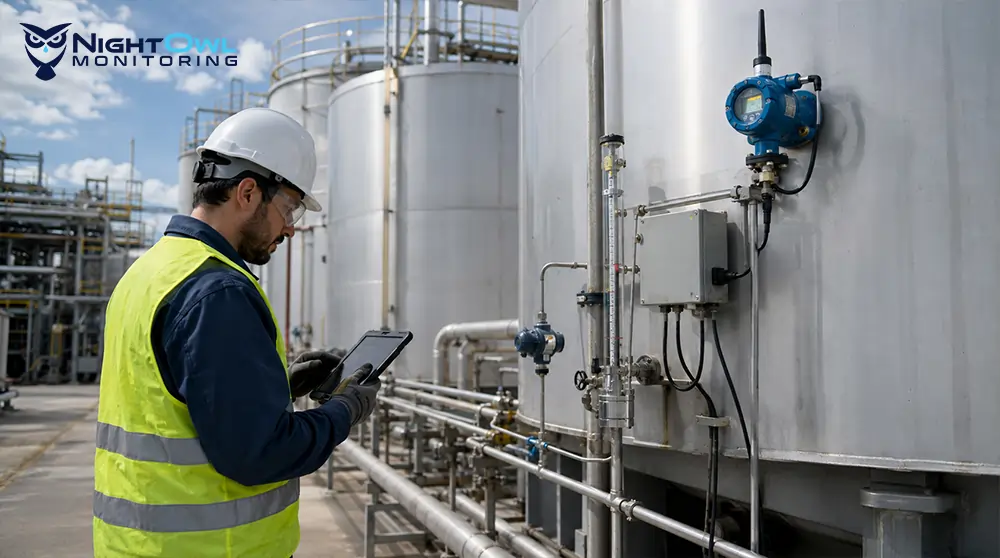
A chemical tank level sensor installed on the tank collects this data, and a remote telemetry unit transmits it to a cloud-based platform. Whether monitoring a single feed tank or hundreds of customer tanks across multiple sites, remote monitoring provides continuous inventory visibility without onsite inspections.
Why Facilities Need Remote Tank Monitoring
Chemical inventory directly affects production. Running out of treatment chemicals, process chemicals, or additives can interrupt manufacturing and force costly emergency deliveries. Overfilled tanks, meanwhile, raise safety and regulatory concerns.
Rather than reacting after a problem occurs, facilities using real-time chemical tank level monitoring can catch changing inventory levels early and schedule replenishment before production is affected. Key benefits include better inventory accuracy, fewer emergency deliveries, improved worker safety, reduced manual inspections, stronger production planning, and lower operating costs advantages that compound for facilities managing multiple storage tanks across several sites or departments.
Understanding the Components of a Chemical Tank Monitoring System
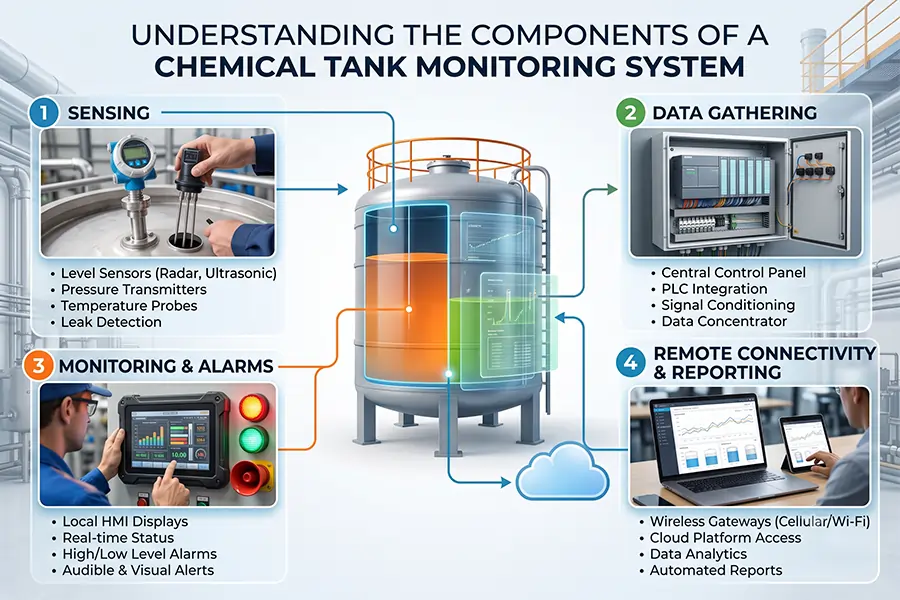
The Tank and the Stored Chemical
Every monitoring system starts with the tank itself. Capacity, height, diameter, shape, orientation, installation type, venting configuration, and construction material all influence which sensor technology delivers the most accurate readings.
The stored chemical matters just as much. Corrosiveness, specific gravity, temperature, foam, vapor, and viscosity determine sensor compatibility choosing the wrong technology can produce inaccurate readings or premature sensor failure.
Tank Level Sensor Technologies
Several sensing technologies are used depending on the application:
| Sensor Type | Best For | Watch Out For |
| Radar | Corrosive chemicals, non-contact measurement, high accuracy | Mounting location and dead-zone limits |
| Ultrasonic | Standard liquids, easy and cost-effective installs | Heavy vapor, foam, condensation, extreme temperatures |
| Hydrostatic/Differential Pressure | Vented or sealed tanks needing direct measurement | Wetted-material compatibility with the chemical |
| Float / Point-Level | Simple level or threshold detection | Limited precision for continuous monitoring |
Radar sensors use electromagnetic waves and never contact the chemical, making them well suited to corrosive substances and applications where reliability is critical. Ultrasonic sensors use high-frequency sound waves and are common on chemical feed tanks, though performance conditions should be checked before installation. Pressure-based sensors estimate level from hydrostatic pressure at the tank bottom and work well for certain vented or sealed tanks, but because they contact the stored chemical directly, wetted materials must be chemically resistant.
Choosing the Right Sensor
No single technology fits every application. The right choice depends on chemical compatibility, tank geometry, operating temperature, vapor and foam conditions, required accuracy, installation constraints, and budget. Evaluating these factors up front rather than defaulting to whichever sensor is already on hand minimizes false readings and maintenance headaches over the life of the system.
Beyond Level Readings
Modern monitoring does more than report how full a tank is. Consumption history, depletion rate, historical trends, inventory forecasting, estimated refill dates, and abnormal usage patterns give operators the insight needed to make proactive inventory decisions rather than simply reacting to a low tank. Over time, this operational data also reveals which tanks consistently run tight and which have built-in slack, informing longer-term decisions about tank sizing, delivery frequency, and safety stock.
Remote Telemetry and Cloud Dashboards
A remote telemetry unit collects sensor data and sends it to the cloud via cellular or other supported communication methods. Units may run on internal battery, external DC or AC power, or solar-assisted systems. When selecting a telemetry solution, consider cellular coverage, reporting frequency, battery life, enclosure rating, operating temperature, and signal reliability.
Raw sensor data becomes actionable once it reaches a cloud dashboard. A good dashboard shows current volume, percentage full, historical usage, fill events, consumption trends, estimated runout dates, active alarms, and device communication status letting operators review dozens or hundreds of tanks from a single interface instead of checking each site separately. Historical reporting built into the dashboard also helps identify seasonal usage patterns, so replenishment schedules can be adjusted ahead of predictable demand swings rather than after inventory has already run short.
Automated Alerts and Alarm History
Waiting until a tank runs dry often means emergency deliveries and production downtime. Modern systems monitor conditions continuously and notify users automatically for low- or high-level alerts, rapid level drops, unexpected usage, possible leaks, overfill warnings, sensor faults, and communication loss giving teams time to respond before inventory problems affect operations.
Maintaining an alarm history also supports troubleshooting. Reviewing past events helps identify recurring low-level conditions, repeated communication failures, abnormal usage patterns, and sensor performance issues, improving long-term maintenance planning.
Smarter Inventory and Delivery Management
Maintaining the right inventory is a balancing act: ordering too early raises storage costs, ordering too late creates operational risk. Connected monitoring gives facilities accurate data on current inventory, safety stock, consumption history, reorder points, and daily usage, replacing guesswork with real operational data. Historical usage trends further support purchasing decisions, seasonal planning, and budget forecasting.
Chemical suppliers face a parallel challenge. Without visibility into customer tank levels, deliveries typically rely on fixed schedules or phone calls, resulting in partially filled routes, emergency runs, and higher transportation costs. With remote monitoring, suppliers can plan deliveries around actual inventory levels, estimated runout dates, customer priority, geography, and truck capacity. Many now offer vendor-managed inventory, monitoring customer tanks directly and scheduling replenishment automatically improving retention, reducing stockouts, and strengthening long-term service relationships.
Chemical Feed Systems and Multi-Site Monitoring
Many facilities use chemical feed systems storage tanks, transfer and dosing pumps, valves, flow meters, and control panels to automate dosing and treatment. Monitoring these systems alongside flow data and pump performance gives maintenance teams a fuller picture of overall system health, not just remaining chemical volume.
Organizations operating multiple facilities face added complexity, since each site may have different inventories, delivery schedules, maintenance teams, and operating conditions. A centralized multi-site platform lets operators review tank levels, alarm conditions, and usage trends across every location from one dashboard, with user permissions and location-based organization simplifying oversight as the number of sites grows.
Integration, Safety, and Cybersecurity
Monitoring becomes more valuable when connected to existing business systems, including SCADA, ERP platforms, routing software, REST APIs, MQTT, Modbus, and CSV exports. These integrations let operational data flow automatically into reporting, inventory updates, and dispatch planning instead of requiring manual entry.
Many industrial chemicals require special handling due to corrosive properties, flammable vapors, or other hazardous conditions, so equipment should be verified for hazardous-location suitability, enclosure ratings, chemical compatibility, and safe mounting before installation. As monitoring systems become more connected, cybersecurity matters too: look for encrypted data transmission, device authentication, role-based access, secure cloud infrastructure, and remote firmware updates to protect both data and infrastructure.
Installation, Commissioning, and Maintenance
A monitoring system is only as reliable as its installation. Commissioning typically includes sensor installation, calibration, field verification, communication testing, dashboard configuration, alarm setup, and user training, ensuring the system is reading and reporting accurately from day one. After go-live, routine maintenance sensor inspection, calibration checks, battery replacement where applicable, communication testing, cable inspection, and firmware updates keeps the system accurate throughout its service life and reduces the odds of an unexpected sensor fault going unnoticed.
Benefits for Operators and Suppliers
For industrial facilities, uninterrupted chemical availability is essential to production. Connected monitoring improves production continuity, inventory accuracy, worker safety, and maintenance planning, freeing staff from manual inspections to focus on higher-value work.
For chemical suppliers, real-time visibility into customer tanks means better delivery scheduling, fewer emergency runs, improved truck utilization, more accurate planning, and stronger customer relationships. Instead of reacting to shortages, suppliers can proactively schedule deliveries before tanks reach critical levels improving service while cutting unnecessary transportation costs and building the kind of long-term account retention that fixed delivery schedules rarely achieve.
Choosing the Right Solution
Not every monitoring system offers the same capabilities. When evaluating a solution, look for accurate level measurement, reliable cellular telemetry, real-time alerts, historical reporting, a cloud-based dashboard, multi-site monitoring, inventory forecasting, integration with existing business systems, secure remote access, and scalable deployment. The right platform should not just measure tank levels it should improve decision-making across the organization.
How NightOwl Monitoring Supports Industrial Chemical Tank Monitoring
Industrial facilities need more than a simple level indicator they need continuous visibility into inventory, automated alerts, and reliable data to support day-to-day decisions. NightOwl Monitoring combines rugged field hardware with a cloud-based platform that helps operators and chemical suppliers remotely monitor critical storage assets, including chemical tank levels, water storage tanks, pump runtime, flow and pressure conditions, and alarm history across multiple locations.
Rather than replacing existing workflows, NightOwl Monitoring complements them giving operators the insight to catch a developing issue early, before a shortage or overfill becomes a costly disruption, and giving suppliers the visibility to plan deliveries proactively.
The Future of Industrial Chemical Storage Management
Industrial operations are becoming more connected and data-driven. Remote telemetry, cloud dashboards, predictive analytics, automated alerts, and multi-site visibility are increasingly standard parts of inventory management rather than optional upgrades. Organizations that adopt these tools now will be better positioned to improve safety, optimize inventory, reduce operating costs, and deliver stronger customer service as facilities and supply chains continue to digitize.
Conclusion
Industrial chemical tank monitoring gives facilities and suppliers the real-time visibility needed to manage inventory more efficiently, improve worker safety, and cut unnecessary operating costs. By combining accurate sensors, remote telemetry, cloud dashboards, and automated alerts, organizations can replace manual inspections with proactive, data-driven inventory management whether monitoring a single tank or hundreds of customer locations across multiple sites.
Frequently Asked Questions
What is industrial chemical tank monitoring?
It uses level sensors, remote telemetry, and cloud software to continuously track chemical inventory, giving real-time visibility into tank levels, usage, and alarm conditions.
Which tank level sensor is best for chemicals?
It depends on the application. Radar suits corrosive chemicals and non-contact measurement, ultrasonic works well for many standard liquids, and pressure sensors suit certain vented or sealed tanks.
How does remote monitoring improve safety?
It reduces manual inspections, provides early alerts for low or high levels, flags abnormal usage, and helps prevent overfills and unexpected shortages.
Can multiple tanks be monitored from one dashboard?
Yes. Cloud-based platforms let operators monitor tanks across several facilities from a single dashboard, with user permissions and location-based organization.
What are the benefits of tank telemetry?
Real-time inventory data, automated alerts, historical reporting, consumption tracking, delivery forecasting, and remote visibility without onsite inspections.
Can suppliers monitor customer tanks remotely?
Yes. Many suppliers use remote monitoring for vendor-managed inventory, proactive delivery scheduling, better truck utilization, and stronger customer relationships.
Does it integrate with existing software?
Most systems support SCADA, ERP platforms, routing software, REST APIs, MQTT, Modbus, and CSV exports.
How often should equipment be calibrated?
It depends on sensor type, environment, and manufacturer guidance regular inspection and periodic field verification help maintain accuracy over time.