 ChatGPT
 Perplexity
 Claude
 Gemini
 Grok
Grok
If your home is on a private well, you have your own water supply system on your property. Instead of water coming from a city main, your water comes from groundwater stored in an underground layer called an aquifer. Your well system’s job is to pull that water up safely, pressurize it, and deliver it to every faucet, shower, toilet, and appliance in the house.
Once you understand the basic parts, it gets a lot easier to troubleshoot low pressure, air in the lines, brown water, or a pump that keeps cycling.
Where Does Well Water Come From?
Well water is groundwater. Rain and snowmelt seep into the ground and slowly recharge the aquifer. Your well is essentially a controlled access point into that groundwater supply.
A few key terms you will hear:
- Water table: The level underground where the soil and rock are fully saturated with water.
- Aquifer: A layer of sand, gravel, or fractured rock that holds and moves water.
- Well yield: How much water the well can produce over time, usually measured as flow rate.
In simple terms, the aquifer is the storage, and the well is your access pipe into it.
The Main Parts of a Home Well Water System
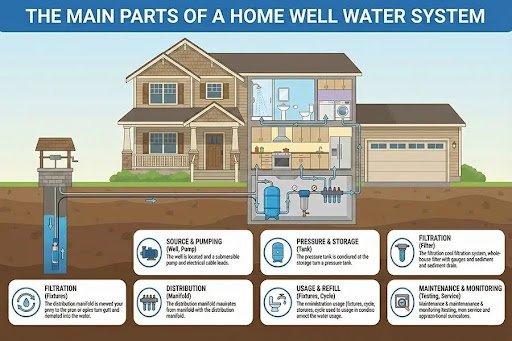
A typical home water well system has these core components working together:
1) The well itself
This is the drilled (or driven) opening into the ground. Most modern residential wells are drilled and lined with a well casing that helps keep the well stable and protected.
2) The pump
The pump moves water from the well into your home. There are two common types:
- Submersible pump: Installed down inside the well, underwater. This is very common for residential wells.
- Jet pump: Usually above ground in the house or a well house, often used for shallow wells.
3) The drop pipe and check valve
A submersible pump pushes water up through a pipe (often called the drop pipe). A check valve helps prevent water from draining back down into the well when the pump turns off.
4) The pitless adapter (for many homes)
This is a sealed fitting that lets the water line exit the well below frost level and travel underground toward the house. It helps keep things protected year-round.
5) The pressure tank
This is the heart of comfort inside the home. The pressure tank stores water under pressure so you get steady flow without the pump turning on every time you open a faucet.
Most modern pressure tanks have an internal bladder that separates air from water. The air side acts like a spring to maintain pressure.
6) The pressure switch
This switch tells the pump when to start and stop.
It works between two pressure points, for example:
- Pump turns on at a lower pressure (cut-in)
- Pump turns off at a higher pressure (cut-out)
This is why your water pressure rises and falls within a normal range.
7) Filters and water treatment (optional but common)
Many well homes use filtration and treatment based on water quality, such as sediment filters, carbon filters, softeners, iron removal, or disinfection equipment. If you need help with choosing the filter you can check out the guide of what micron filter is best for well water.
How Does Well Water Work in a House Step by Step?
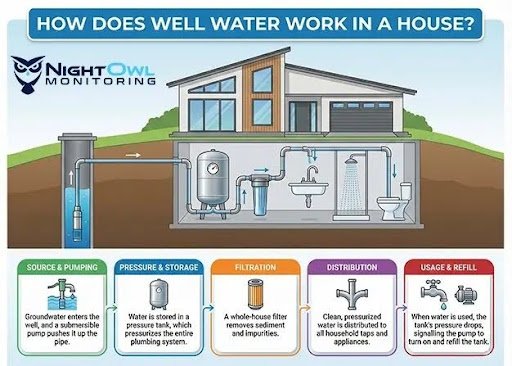
Here is the normal cycle of how well water works in a house:
Step 1: You turn on water
You open a faucet, start a shower, or run an appliance. Water initially comes from the pressure tank, not directly from the well.
Step 2: Pressure drops
As water leaves the pressure tank, the pressure in the system gradually drops.
Step 3: The pressure switch turns the pump on
When pressure reaches the cut-in setting, the pressure switch signals the pump to start.
Step 4: The pump refills the tank and supplies the house
While the pump is running, it pushes water into the home’s plumbing and also refills the pressure tank.
Step 5: The pump turns off
When pressure reaches the cut-out setting, the switch shuts the pump off. The pressure tank remains full and ready for the next water use.
This is the basic answer to “how do wells work for a house” and once you see it as a cycle, the system makes a lot more sense.
A Simple Well to House Plumbing Diagram in Words
If you are searching for a “well to house plumbing diagram,” here is the flow in order:
Aquifer → Well screen/open intake area → Pump → Check valve → Pitless adapter → Underground water line → Pressure tank → Pressure switch → Filters/treatment (if installed) → Home plumbing
That is the complete path from groundwater to your kitchen sink.
What Makes Well Water Pressure Feel Strong or Weak?
If someone says “my well water pressure is low,” it usually comes down to one of these:
- Pressure switch settings are set low
- Pressure tank has an air charge problem or failing bladder
- A filter or treatment system is clogged and restricting flow
- The pump is wearing out and cannot reach higher pressure
- The well water level is dropping and the pump is struggling under demand
- Plumbing restrictions or partially closed valves exist
A quick clue that helps:
- If pressure starts strong then fades, the well may be drawing down or a restriction is building as flow increases.
- If pressure is always weak everywhere, it is often a setting, tank issue, or clogged filtration.
What Should You Know About Well Water Quality?
Well water quality can be excellent, but it is also your responsibility to test and treat when needed. Common well water issues include:
- Sediment and turbidity (cloudy or gritty water)
- Iron and manganese (orange, brown, or black staining)
- Hard water minerals (scale buildup)
- Bacteria risk if the well is compromised
- Sulfur odor or taste issues in certain areas
A smart routine is:
- Test your water periodically, especially if anything changes in taste, color, or smell
- Keep the well cap secure and the wellhead area graded so surface water drains away
- Maintain filters and treatment equipment on schedule
Common Well System Problems and What They Usually Mean
The pump keeps turning on and off quickly
This is often called short cycling. It is commonly linked to a pressure tank issue, incorrect air charge, or a leak.
The pump runs but you get little water
This can be a loss of prime (common with jet pumps), a clogged line, a failing pump, or a low water level problem.
Water turns brown after rain or heavy use
Often sediment disturbance, iron, or changes in well conditions. Repeated events can indicate a wellhead vulnerability or a damaged screen.
Pressure is fine, but flow is weak when multiple fixtures run
That is often a flow capacity issue, either from restrictions, pump sizing, or well yield limits.
How NightOwl Monitoring Fits Into a Home Well System
Most well problems do not show up as one big dramatic failure. They show up as small changes first, such as longer pump run time, extra cycling, pressure instability, unusual drawdown, or flow patterns that do not match normal usage.
NightOwl Monitoring helps well owners and operators by adding visibility into system behavior, especially when you manage a well house, a farm system, a community well, or multiple sites. With real-time data and alerts, you can spot abnormal trends early, catch leaks sooner, protect pumps from stressful conditions, and make decisions based on what the system is actually doing rather than guessing.
It is the same well system concept, just with smarter insight and faster response when something changes.
Pros and Cons of Well Water in a House
Benefits
- You control your water supply and do not pay a monthly water bill for usage
- Water can be very fresh and consistent when the system is maintained
- Good fit for rural properties and larger lots
Tradeoffs
- You handle maintenance and repairs
- You need periodic water testing
- Power outages can stop water flow unless you have backup power
- Some areas require treatment for minerals, sediment, or bacteria protection
FAQs
What is well water?
Well water is groundwater pumped from an aquifer on your property and delivered to your house through a private well system.
How does a well work for a house?
A pump pulls water from the well, a pressure tank stores it under pressure, and a pressure switch turns the pump on and off to keep pressure within a normal range.
Where does the water in a well come from?
It comes from groundwater stored in an aquifer, replenished by rain and snowmelt soaking into the ground.
Why does my water pressure change on well water?
Pressure naturally rises and falls between the pump’s on and off settings. Big swings, rapid cycling, or sudden weakness usually indicate a tank, switch, restriction, pump, or well supply issue.