
 ChatGPT
 Perplexity
 Claude
 Gemini
 Grok
Grok
If you replaced a whole-house filter and still ended up with cloudy water, weak shower pressure, or a cartridge that clogged in weeks instead of months, the micron rating was probably wrong for your situation. Not wrong in a complicated way, just mismatched to your actual sediment load or installed in the wrong sequence.
This guide answers the question directly, then gives you the context to understand why: what micron ratings mean, how the common sizes compare, when to use multiple stages, and how to match filtration to what is actually in your well water rather than guessing.
The short answer: For most residential wells, a 20-micron pre-filter followed by a 5-micron main sediment filter covers the majority of situations without sacrificing household water pressure. Add finer stages only after your water test and pressure budget support it.
Key Takeaways
- A lower micron number = smaller pores = finer filtration, but also more pressure drop and faster clogging when sediment loads are heavy.
- A 5-micron filter is the workhorse for whole-house well water filtration. It removes fine silt and sediment without restricting flow as severely as finer options.
- A 20-micron filter should almost always come first when your well has visible sediment, sand, or rust. It protects your finer downstream cartridges from premature fouling.
- Smaller micron is not always better. Installing a 1-micron filter without a coarse pre-filter ahead of it on a sandy well is a reliable way to destroy water pressure within weeks.
- The right micron setup depends on your water test results, your available water pressure, and your household flow demand. All three factors interact.
- A sediment filter does not address dissolved contaminants like iron, nitrates, hardness, bacteria, or PFAS. It only removes physical particles. Additional treatment stages handle dissolved substances.
- Filter performance degrades gradually. Pressure drop that builds slowly over weeks often goes unnoticed until flow is significantly restricted.
What Is a Micron and What Does a Micron Rating Mean?
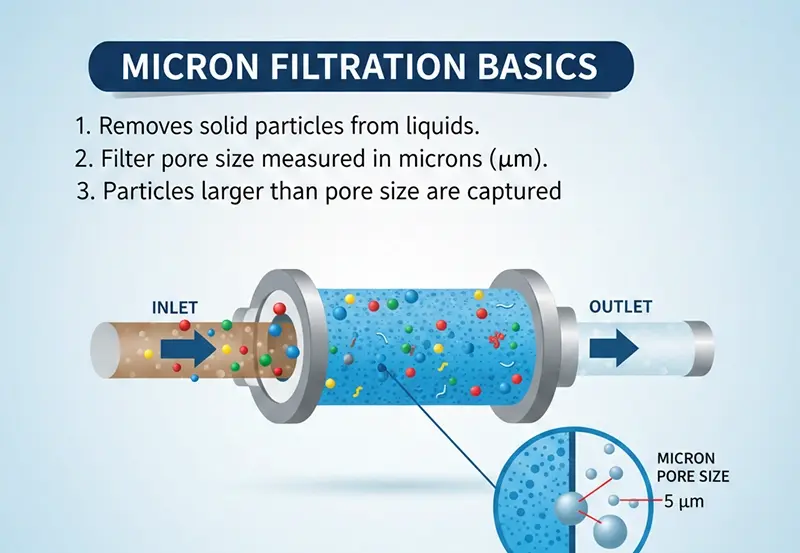
A micron (abbreviated µm, also written as micrometer) is a unit of length equal to one millionth of a meter, or 0.001 millimeter. For reference, a human hair is typically 70 to 100 microns wide. The naked eye can see particles down to about 40 microns. Everything below that is invisible without magnification.
A filter’s micron rating describes the approximate size of the smallest particle it is designed to capture. A 5-micron filter, for example, is designed to stop particles 5 microns and larger from passing through. A 20-micron filter lets through anything smaller than 20 microns.
Two important clarifications that matter for well water:
Nominal vs. absolute ratings. Most sediment filter cartridges carry a nominal micron rating, meaning they capture a percentage (often 85 to 98%) of particles at that size but not all of them. An absolute-rated filter blocks essentially all particles at or above the stated size. For drinking water applications requiring reliable bacterial reduction, absolute-rated filters or certified absolute ratings matter significantly. For general sediment prefiltration, nominal ratings are standard.
Micron ratings do not describe chemistry. A sediment filter at any micron rating removes physical particles only. Iron that has oxidized into rust particles will be caught. Iron dissolved in water (ferrous iron, which makes the water look clear but stains fixtures when it oxidizes at the faucet) passes right through. Nitrates, hardness minerals, bacteria, arsenic, PFAS, and most other water quality concerns require dedicated treatment stages beyond sediment filtration.
The Water Filter Micron Chart: What Each Rating Catches
| Micron Rating | What It Catches | Typical Well Water Use |
|---|---|---|
| 100 micron | Coarse debris, large sand grains, visible particles | Rarely used alone; sometimes used in irrigation pre-filters |
| 50 micron | Fine sand, large silt particles, visible rust flakes | First stage on wells with heavy visible sediment; common in spin-down screen filters |
| 25 micron | Fine sand and silt, smaller rust particles | Pre-filter stage; transitional between coarse and medium |
| 20 micron | Fine sand, silt, and grit; smaller rust and scale | Most common pre-filter stage for residential wells; protects downstream cartridges |
| 10 micron | Finer silt and sediment, smaller rust particles | Intermediate stage; useful when 5 micron clogs too fast on your specific well |
| 5 micron | Fine silt, clay particles, rust, scale | Standard whole-house sediment main stage; the most common choice for well water |
| 1 micron | Very fine silt, some bacteria-sized particles, colloidal iron | Polishing stage after coarser stages; requires adequate pressure and low sediment load upstream |
| 0.5 micron | Very fine particles, some cysts (Giardia, Cryptosporidium) | Point-of-use only in most cases; significant pressure drop |
A human red blood cell is about 6 to 8 microns. Most bacteria range from 0.5 to 5 microns. A Giardia cyst is approximately 8 to 12 microns. These reference points help put filter ratings in context.
5 Micron vs 20 Micron: Which Is Better for Well Water?
This is the most searched comparison for residential well filtration, and the honest answer is that “better” depends entirely on where in the system the filter is installed.
20 micron is better as a first stage when your well produces visible sediment, sand, grit, or rust. At 20 microns, the filter catches larger particles that would otherwise foul a finer cartridge within days or weeks. It also causes less pressure drop than a 5-micron filter, which matters when household flow demand is high. The trade-off is that finer particles, clay, colloidal silt, and small iron particles pass through a 20-micron filter and continue downstream.
5 micron is better as the main sediment stage after a coarser pre-filter has removed the heavy load. It catches fine silt and clay that a 20-micron filter misses and is the most common recommendation for whole-house well water sediment control. The trade-off is that it clogs faster when heavy sediment reaches it, which is exactly why a coarser pre-filter stage matters.
In a properly designed system, you use both. A 20-micron first stage extends the life of the 5-micron main stage by removing the bulk of the heavy sediment. The 5-micron stage then handles the finer particles that make it past the first filter. Most homeowners who are frustrated with constantly replacing 5-micron cartridges are either missing a coarse pre-filter or have one that is inadequately sized.
If you must choose only one: use 20 micron if your well produces clearly visible sediment and pressure is a concern. Use 5 micron if your well has only light to moderate fine sediment and your system has adequate pressure.
Is 5 Micron Better Than 10 Micron?
For most residential wells, yes, a 5-micron filter provides meaningfully better fine sediment removal than a 10-micron filter. The difference is noticeable in water clarity and in the protection of downstream equipment like water heaters, water softeners, and appliance inlet valves.
However, 10 micron is a reasonable choice when:
- Your well has relatively low sediment and you have already confirmed that 5-micron filters clog too quickly for practical maintenance schedules.
- Your household pressure is limited and the additional pressure drop of a 5-micron cartridge creates noticeable flow problems.
- You are adding a 10-micron stage between a coarse pre-filter and a finer polishing stage in a multi-stage system.
The 10-micron filter occupies a useful middle position in multi-stage systems but should not typically replace a 5-micron filter as the primary whole-house stage unless well-specific conditions support it.
Is 5 Micron Better Than 25 Micron?
For different jobs. A 25-micron filter does the same job as a 20-micron filter at slightly different granularity. It removes larger sand, silt, and grit but passes finer particles. As a standalone whole-house sediment filter, a 25-micron rating leaves too much fine sediment in the water.
The typical role for 25-micron filtration is the same as 20-micron: a coarse pre-filter stage protecting a finer 5-micron main stage. Some filter housings are sold with 25-micron cartridges as the starter recommendation; these work correctly when followed by a finer stage.
When to Use a 1 Micron Filter (and When Not To)
A 1-micron filter is a polishing stage, not a first-stage filter. It is designed to catch what finer sediment slipped through coarser stages and to reduce colloidal particles that contribute to cloudiness even when the water appears mostly clear.
Good reasons to add a 1-micron stage:
- You have already installed coarser stages (20 micron + 5 micron) and want additional clarity
- Your drinking water point-of-use system requires fine prefiltration before a carbon block or RO membrane
- Your water test shows colloidal iron that is not fully addressed by 5-micron filtration
- Your household pressure supports the additional pressure drop (typically 1 to 3 PSI additional drop at design flow)
Poor reasons to use a 1-micron filter:
- Installing it as the only or first-stage filter on a well with sandy or silty water
- Adding it to a system that already struggles with low pressure
- Using it to replace a 5-micron filter as the main stage
A 1-micron cartridge installed as the sole filter on a heavily silted well will need replacement within days and will produce a noticeable pressure drop immediately. The fix is not a better cartridge: it is adding appropriate coarser stages ahead of it.
50 Micron vs 100 Micron: When Coarser Filters Are the Answer
Very coarse filtration has a specific role that goes beyond whole-house sediment control. A 50-micron or 100-micron screen or spin-down filter is appropriate in several situations:
- As the very first component in a multi-stage system on a well that produces heavy sand or grit, protecting everything downstream including finer filter cartridges and the pressure tank bladder
- On irrigation systems where pressure drop must be minimized and fine filtration is not required
- On new wells during the break-in period when sand production is temporarily higher than it will be in steady-state operation
- On wells where the aquifer formation produces coarse material that the well screen does not fully stop
A spin-down filter (a reusable mesh screen filter with a flush valve) at 50 to 100 microns can be flushed without replacing a cartridge, making it a low-maintenance first stage that significantly extends cartridge life in the stages that follow it.
How to Choose the Right Micron Filter for Your Specific Well
The most common mistake in filter selection is choosing a micron rating based on what a store shelf recommends without accounting for what is actually in the water. Two wells a mile apart can have dramatically different sediment characteristics, and the same micron filter that works perfectly for one homeowner causes constant clogging problems for the neighbor.
Step 1: Test the water before selecting filtration
A water test reveals what is in the water, which determines what filtration approach is actually needed. For sediment filtration specifically, a turbidity test tells you how much particulate matter is present. Visual inspection of your existing filter cartridges when you replace them tells you a lot too: cartridges that are brown and silty failed due to iron oxide particles and fine clay; those with gritty sandy deposits point to coarser particle intrusion from the well screen or pump.
For broader water quality, testing for iron, manganese, bacteria, nitrates, pH, hardness, and other parameters identifies what additional treatment is needed beyond physical sediment filtration. A sediment filter cannot and does not address any of these dissolved contaminants.
Step 2: Assess your available water pressure
Measure household water pressure at a hose bib or pressure gauge before any filtration equipment. Most residential well systems operate between 40 and 60 PSI. Each filter stage adds a pressure drop at the design flow rate, typically 1 to 5 PSI per stage depending on micron rating, cartridge type, and flow rate. Adding multiple fine-stage filters to a system already running at 40 PSI can create noticeable pressure problems at showers and appliances.
If pressure is limited, prioritize the coarser stages and stop the whole-house filtration at 5 micron or 10 micron, adding finer treatment only at the point of use where it is needed most (the kitchen sink for drinking water).
Step 3: Match the filter sequence to your sediment type
| Water Condition | Recommended Sequence |
|---|---|
| Light sediment, clear water, low turbidity | Single 5-micron whole-house filter |
| Moderate sediment, occasional cloudy water | 20-micron pre-filter + 5-micron main stage |
| Heavy sand or grit, frequent filter clogging | 50-micron spin-down (reusable) + 20-micron + 5-micron |
| Fine silty water, high turbidity | 20-micron depth filter + 5-micron + 1-micron polishing |
| Drinking water polishing after whole-house | Whole house to 5-micron, then 0.5-micron carbon block at tap |
Step 4: Choose the right cartridge type for your sediment
Sediment cartridge types matter, not just the micron rating on the label:
Spun or melt-blown polypropylene: Dense fiber matrix with consistent filtration throughout the depth of the cartridge. Good all-around choice for well water sediment; holds a relatively high sediment load before restrictive pressure drop. The most common and reliable option for most residential wells.
String-wound: Gradient density from outside (coarser) to inside (finer). Handles high-sediment loads well but can unwind and release particles if flow rate exceeds the rating. Less commonly used in whole-house applications.
Pleated polyester: Large surface area in a pleated configuration, which extends cartridge life under high flow. Less common for fine-sediment applications but useful for coarser pre-filtration stages.
Block (carbon or ceramic): Used for chemical treatment or very fine filtration, not for primary sediment removal in well systems. These are point-of-use stages, not whole-house sediment stages.
Sediment Filtration and Well Pump Health
There is a direct connection between sediment filtration and well pump longevity that is underappreciated by most homeowners. Fine sand and silt that passes through an inadequate or clogged filter does not disappear. It reaches the pump, the pressure tank, the water heater, and appliance inlet valves.
Inside a submersible well pump, fine abrasive particles act like sandpaper on the impeller and wear rings. A pump running in silty water will fail years earlier than the same pump in clean-filtered water. A pressure tank bladder that repeatedly receives fine grit develops small abrasion points that lead to premature bladder failure. Water heater tanks accumulate sediment at the base, reducing efficiency and eventually damaging the heating element.
Proper sediment filtration protects the entire downstream system, not just the water quality at the faucet. Understanding how a pressure tank for a water well works helps clarify why protecting it from sediment intrusion matters as much as what comes out of the tap.
How Often Should Well Water Filters Be Changed?
Cartridge replacement interval depends on sediment load and filter capacity, not just time. A homeowner with heavily silted well water may need to replace a 5-micron cartridge monthly. Another with light sediment may go six months or longer on the same cartridge.
General guidance by stage:
- Coarse pre-filter (20 to 50 micron cartridge): Every 3 to 6 months, or when pressure drop across the filter exceeds 5 to 8 PSI at normal flow
- Main sediment filter (5 to 10 micron): Every 3 to 6 months, adjusted based on how quickly your pre-filter loads up
- Polishing stage (1 micron or finer): Every 3 to 6 months, or per manufacturer specification
A reusable spin-down screen at 50 to 100 microns can be flushed monthly instead of replaced, significantly reducing maintenance cost and frequency for the cartridge stages downstream.
The most reliable indicator that a cartridge needs changing is pressure drop across the filter housing, not calendar time. A pressure gauge on each side of the filter housing lets you monitor this directly. When the differential pressure reaches 8 to 10 PSI across a single stage, flow restriction is significant enough to warrant replacement regardless of how recently the last cartridge was installed. Clogging and its effect on pump cycling is one of the system behaviors that NightOwl well monitoring systems track through pressure and pump runtime trends, helping operators catch gradual restriction before it becomes a flow problem.
Nominal vs. Absolute Micron Rating: Why It Matters for Bacteria
For most sediment filtration purposes on residential wells, nominal micron ratings are adequate. But if your water test has revealed bacterial contamination or you are selecting filtration specifically intended to remove pathogens, the distinction between nominal and absolute ratings becomes critical.
A nominal 1-micron filter does not guarantee that all bacteria are stopped. Bacteria typically range from 0.5 to 5 microns in size, and a filter rated nominally at 1 micron may allow some smaller organisms through. For reliable microbial reduction, an absolute-rated filter at 0.5 micron or smaller, or a certified ceramic filter, combined with UV disinfection is the appropriate approach.
A sediment filter, regardless of micron rating, is not a substitute for disinfection. If your water test shows coliform bacteria or E. coli, the response involves identifying and addressing the contamination source, shock chlorination or disinfection, and potentially a UV system, not simply installing a finer sediment filter. The guide on what coliform bacteria in well water means covers when this becomes a health concern and what steps address it properly.
Is Higher or Lower Micron Better?
Neither. The right micron rating is the one that matches your sediment particle size, sediment load, and available pressure, in the correct sequence within a multi-stage system.
Higher micron (coarser) is better when: you are placing the first stage on a well with heavy visible sediment, your pressure is limited, or you are protecting finer cartridges downstream from rapid fouling.
Lower micron (finer) is better when: you need fine particle removal, you are in a later stage after coarser filters have done the heavy lifting, or you need point-of-use polishing for drinking water.
The framing of “higher vs. lower” suggests a linear tradeoff when the real answer is that a properly staged system uses both, each in its correct position.
How Does Filter Clogging Affect Your Well System?
A clogged sediment filter does not simply stop filtering. It restricts flow, which creates a cascade of effects through the rest of the system:
- Pressure at fixtures drops below comfortable levels for showers, filling containers, and irrigation
- The pressure switch signals the pump to run longer to maintain system pressure against the restriction
- Extended pump run times increase motor wear and energy consumption
- Rapid pressure cycling can develop as the tank pressure swings more sharply under restricted flow
- In severe cases, a badly clogged filter can create enough restriction that the pump cannot reach its cut-off pressure at all, causing it to run continuously
Most homeowners do not track filter clogging as a system event because the pressure drop is gradual. A filter that restricts flow by 30% over eight weeks does so imperceptibly week by week. This is why monitoring pump runtime and system pressure over time reveals filter degradation that a periodic visual check of the filter housing does not. The NightOwl Hawk monitoring system tracks these pressure and runtime patterns continuously, which is particularly useful for well contractors managing multiple properties or remote well systems.
The Complete Recommended Micron Filter Setup for Well Water
Pulling everything together, here are the recommended filter configurations based on water condition:
Scenario 1: Light sediment, clear water
Water test shows low turbidity, no visible particles, no history of clogging problems.
Setup: Single 5-micron whole-house sediment filter. No pre-filter required. Change every 3 to 6 months or when pressure drop across the housing exceeds 8 PSI.
Scenario 2: Moderate sediment, occasional cloudiness
Water has some turbidity, existing filter cartridges load up in 4 to 8 weeks, some fine particles visible.
Setup: 20-micron pre-filter + 5-micron main stage. Consider a spin-down screen ahead of the pre-filter if sand grains are visible. This configuration significantly extends cartridge life for the main 5-micron stage.
Scenario 3: Heavy sediment, sandy well, frequent clogging
Existing filters clog within days or weeks. Visible sand or grit in the water. Well screen may be allowing formation material through.
Setup: 50-micron reusable spin-down screen (flush weekly or as needed) + 20-micron cartridge pre-filter + 5-micron main stage. This three-stage approach dramatically extends cartridge life and maintains household pressure. If this setup still produces rapid clogging, the root cause is likely a well screen issue that filtration cannot permanently solve.
Scenario 4: High clarity drinking water at specific fixtures
Whole-house filtration adequate for general use but you want high-clarity water for cooking and drinking at the kitchen sink.
Setup: Whole-house to 5-micron (or 20 + 5 if sediment is moderate), then a dedicated under-sink 1-micron or 0.5-micron carbon block filter at the kitchen tap. This approach protects household pressure for showers and laundry while delivering polished water where it is consumed.
Frequently Asked Questions
What micron filter is best for well water?
For most residential wells, a 20-micron pre-filter followed by a 5-micron main whole-house filter is the best starting point. If sediment is heavy, add a 50-micron reusable spin-down screen before the 20-micron stage. If your water test shows only light sediment, a single 5-micron filter may be all that is needed.
Which is better, 5 micron or 20 micron?
Neither is universally better. A 20-micron filter is better as a first stage when visible sediment is present; it protects finer cartridges from premature fouling and causes less pressure drop. A 5-micron filter is better as the main sediment removal stage for fine particles that 20 micron lets through. In most well systems with moderate to heavy sediment, you need both in sequence.
Is 5 micron better than 25 micron for well water?
As a standalone filter: yes, 5 micron removes significantly more fine sediment. As a sequence: use 25 micron (or 20 micron) as a first stage, then 5 micron as the main stage. The 25-micron filter protects the 5-micron stage from clogging too quickly.
Is a 5 micron filter good for well water?
Yes, a 5-micron sediment filter is a well-proven choice for whole-house well water filtration. It removes fine silt, clay, rust particles, and scale without the severe pressure drop that finer options create. Pair it with a coarser pre-filter for best results when sediment loads are moderate to heavy.
Is higher or lower micron better for water filtration?
Lower micron removes finer particles but restricts flow more and clogs faster. Higher micron passes more flow but misses smaller particles. The best setup matches the micron rating to the particle size of the actual sediment in the water and places coarser stages first to protect finer stages downstream.
How many microns should a whole-house water filter be?
A 5-micron filter is the most widely recommended whole-house sediment stage for well water. If sediment is heavy, precede it with a 20 to 50-micron stage. If your pressure and maintenance schedule support it, follow it with a 1-micron polishing stage.
What size sediment filter for well water?
Micron rating and physical cartridge size are separate choices. For most whole-house systems, a 4.5 x 20-inch big blue housing provides significantly more filter surface area and lower pressure drop than a standard 2.5 x 10-inch cartridge at the same micron rating. Larger housings extend cartridge life and better maintain flow in high-sediment applications.
Do sediment filters remove bacteria?
No. Sediment filters at any common micron rating (1, 5, 10, 20) are not reliable for bacterial removal. Even a 1-micron nominal filter may allow bacteria smaller than 1 micron through. Bacterial treatment requires UV disinfection, chlorination, or an absolute-rated ceramic filter specifically certified for microbial reduction.
Final Takeaway
Micron filter selection for well water is less about finding the smallest possible number and more about matching the right sizes to your specific sediment, in the right sequence, without sacrificing system pressure. For most wells, the 20-micron + 5-micron combination handles the majority of situations effectively. Add coarser stages when sand is heavy. Add finer stages when pressure allows and the water test justifies it.
The other half of the equation is knowing when your filters need changing. Gradual pressure drop from clogging is easy to miss week to week and compounds into real pump strain over time. Monitoring system pressure and pump behavior catches this before it becomes a problem.