 ChatGPT
 Perplexity
 Claude
 Gemini
 Grok
Grok
Low water pressure in a house on a well can be incredibly frustrating. One minute your shower feels normal, the next minute it turns weak when someone runs a sink or the washing machine starts. The good news is that most well water pressure problems come from a small set of causes, and once you identify the real bottleneck, the fix is usually straightforward.
In this guide, you will learn how to increase water pressure in house with well step by step. We will cover easy adjustments, the most common equipment issues, and proven upgrades like constant pressure systems and booster pumps. I will also show where NightOwl Monitoring fits into the bigger picture by helping you see pressure, pump behavior, and system performance clearly, so pressure issues get diagnosed faster and prevented more often.
First, Know This: Pressure and Flow Are Not the Same
Many homeowners say “low pressure,” but the system might actually be struggling with flow rate, not pressure. Here is the difference in plain terms:
- Water pressure is the force pushing water through the pipes.
- Flow rate is how much water you can get at once.
You can have decent pressure at one faucet, but still get weak showers when multiple fixtures run because the well cannot keep up with demand or the plumbing is restricting flow.
A quick clue:
- If pressure starts strong but drops after a minute or two, that often points to a well yield, pump, pressure tank, or control issue.
- If pressure is weak all the time, the problem is often a setting, restriction, clog, or failing component.
Common Reasons for Low Water Pressure in a House With a Well
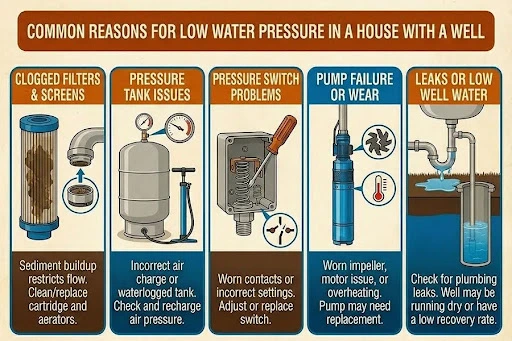
Before you start changing settings, it helps to understand the usual culprits:
Pressure switch settings are too low
Most well systems use a pressure switch that turns the pump on and off between two numbers, like 30 to 50 PSI or 40 to 60 PSI. If yours is set low, the house will feel weak.
Pressure tank problems
If the pressure tank is waterlogged or the air charge is off, you can get short cycling, pressure swings, and weak flow.
Sediment clogged filters or treatment equipment
A clogged sediment filter or water softener can choke water flow and make pressure feel low at every fixture.
Failing pump or worn impeller
Older pumps can lose performance gradually. You might still get water, but not enough pressure, especially during peak use.
Plumbing restrictions
Corroded pipes, partially closed valves, or small diameter plumbing can reduce flow and make pressure worse.
Low well water level or poor well yield
If your well cannot produce enough water fast enough, pressure will drop under demand. Sometimes the pump starts pulling air or the system struggles to recover.
Air in Prime Port of Pump
If air enters the prime port, your pump may struggle to build proper pressure and lose suction. In this case, you may need to re-prime the pump correctly follow our step-by-step guide on how to prime a pump for well water to restore normal operation.
Step 1: Check the Simple Things First
Before you touch your pressure switch or buy equipment, do these fast checks:
Confirm shutoff valves are fully open
Make sure the main shutoff valve and any valves near filters, softeners, or pressure tanks are fully open.
Check for a clogged whole house filter
If you have a cartridge filter, check the pressure drop across it or replace it if it is overdue. A clogged filter is one of the most common reasons for low well water pressure in house systems.
Check faucet aerators and showerheads
If only one fixture is weak, clean the aerator or showerhead screen. That is a fixture problem, not a well problem.
Look for signs of a leak
A continuous pump run, frequent cycling, or unexplained wet spots can indicate a leak. Leaks reduce pressure and make pumps work harder.
Step 2: Read Your Pressure Gauge Like a Pro
Your well pressure gauge is the fastest way to learn what is happening.
Watch it when no water is running:
- It should rise to cut off pressure and stop.
- It should hold steady without dropping.
Watch it when you run a faucet:
- It should drop slowly.
- The pump should turn on at cut in pressure and recover normally.
Red flags:
- The gauge bounces rapidly, this often means pressure tank issues.
- The pump runs but pressure barely rises, this can indicate pump wear, clogging, or low well recovery.
- Pressure drops to near zero under demand, this can indicate severe restriction, failing pump, or low well supply.
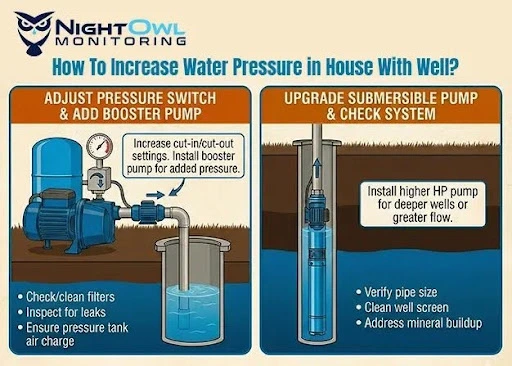
Step 3: How To Increase Well Water Pressure by Adjusting the Pressure Switch
If your system is healthy, one of the simplest ways to increase well water pressure is adjusting the pressure switch. This is where many homeowners go first, but it must be done carefully.
Common switch ranges
Many systems are set to:
- 30 to 50 PSI
- 40 to 60 PSI
If you are at 30 to 50, moving to 40 to 60 can make showers feel noticeably stronger.
Important caution
Do not raise pressure unless:
- Your pressure tank is rated for it
- Your plumbing can handle it
- Your pressure relief valve is appropriate
- Your pump can actually reach the higher cut off pressure
If you raise cut off pressure too high, the pump may run longer, overheat, or never shut off.
General approach
- Turn off power
- Remove the switch cover
- Make small adjustments, then test
- Watch that the system reaches cut off reliably
- Confirm the tank air charge matches your cut in pressure
If you are not comfortable working near electrical components, this is a good time to call a well professional.
Step 4: Fix Pressure Tank Problems That Kill Water Pressure
A weak pressure tank can make it feel like your well system has no power, even if the pump is fine.
Common pressure tank symptoms:
- Rapid on off cycling
- Pressure swings
- Pump turns on too often
- Water pressure feels uneven
What usually fixes it
- Correct air charge in the tank
- Replace a failing tank bladder if it is damaged
- Confirm pressure switch is working properly
A properly working pressure tank smooths pressure and reduces pump stress. That alone can make your whole house feel more consistent.
Step 5: Improve Well Water Pressure by Removing Restrictions
If your system pressure is okay at the tank but weak in the house, the issue is often restriction.
Check and replace sediment filters
Sediment is common with well water. Filters protect your plumbing, but once clogged they choke flow. A fresh cartridge can immediately improve water pressure well water systems.
Inspect water softeners and treatment systems
Some softeners and treatment units have bypass valves. Testing pressure with the unit bypassed can tell you if the unit is restricting flow.
Check the pressure regulator if you have one
Some homes have a pressure reducing valve or a regulator installed. If it is failing or set low, it can limit house pressure.
Consider pipe sizing and old plumbing
Older galvanized pipes can corrode internally and reduce effective diameter. That creates chronic low pressure and low flow.
Step 6: When You Need More Than Settings, Upgrade the System
If you have already checked the basics and your system still struggles under demand, the best solution often comes from a smart upgrade.
Option 1: Install a constant pressure system for well
A constant pressure setup uses a controller or variable speed drive so the pump adjusts output smoothly as demand changes. This reduces pressure swings and gives a more city like feel.
If your goal is stable showers and consistent pressure while multiple fixtures run, this is one of the best long term upgrades.
Option 2: Add a water well booster pump
A booster pump can help if the well produces enough water but the house needs stronger pressure or better delivery. It is especially helpful for larger homes, long pipe runs, or irrigation zones.
A booster pump is not a fix for a low producing well. If the well cannot supply water, boosting pressure will not create more water.
Option 3: Upgrade to a high pressure well pump
Some homes benefit from a pump designed for higher head pressure. This depends on your well depth, plumbing layout, and system demand.
Step 7: Low Pressure That Comes and Goes, Focus on Well Yield and Water Level
If your pressure is okay in the morning but weak later, or it starts strong then fades, the well may be running behind demand.
Signs your well yield is the issue:
- Pressure drops after sustained use
- Pump runs longer than usual
- The system takes a long time to recover
- You notice air sputtering at faucets
In these cases, solutions may include:
- Reducing peak demand
- Staggering water heavy appliances
- Increasing storage capacity
- Working with a well professional to evaluate well performance
This is also where monitoring becomes valuable, because it is hard to diagnose water level and pump performance changes by guesswork alone.
How NightOwl Monitoring Helps You Fix Low Well Water Pressure Faster
Water pressure problems are often a chain reaction. A small leak causes the pump to run longer. A longer run heats the pump and increases wear. A failing component creates pressure swings, and the homeowner just feels weak fixtures.
NightOwl Monitoring helps by giving you clarity into what the system is actually doing, including:
- Pressure behavior and sudden drops
- Pump runtime and cycle frequency changes
- Flow patterns that hint at leaks or restrictions
- Water level behavior that explains pressure loss during heavy use
- Alerts when operating conditions shift outside normal ranges
Instead of guessing, you can see the pattern and correct the cause before it becomes an emergency.
Quick FAQ
Can you increase water pressure on a well?
Yes, in many cases. You can often improve pressure by adjusting the pressure switch, fixing tank air charge issues, replacing clogged filters, or upgrading to a constant pressure system. The right solution depends on whether your problem is pressure, flow, or well yield.
How to get better water pressure from a well without replacing the pump
Start with the basics: replace clogged filters, confirm valves are open, fix pressure tank issues, and check pressure switch settings. Many systems feel dramatically better after these corrections.
Why is my water pressure low only when more than one faucet runs?
That usually points to limited flow capacity, a restriction, or a well supply limitation rather than a simple pressure setting issue.
What is the best upgrade for consistent pressure?
A constant pressure system is one of the best upgrades when you want stable pressure under changing demand.
Final Takeaway
If you want to increase water pressure in house with well, start with the simple checks, then move to the real system diagnostics. Many pressure issues come down to pressure switch settings, tank air charge, clogged filters, or restrictions. If your home demand has grown, a constant pressure system or booster pump can transform the feel of your water.
If you want, I can also create the metadata for this blog post, plus a short internal linking plan connecting it to your other NightOwl Monitoring guides on pump priming, pressure monitoring, and water level monitoring.