 ChatGPT
 Perplexity
 Claude
 Gemini
 Grok
Grok
Case Study: Municipal Costs vs Private Water Wells
The financial landscape of water infrastructure is shifting rapidly across the country. Recent projections indicate that if communities rely solely on rate revenue to close growing infrastructure gaps, average annual household drinking water bills will rise from $429 in 2025 to $969 by 2050. This trajectory, which more than doubles the cost of municipal water in real terms, forces property owners, drillers, and utility managers to reevaluate their long-term supply strategies. For those in rural or semi-rural areas, the decision between connecting to a community system and drilling private water wells is no longer just about immediate convenience. It is a complex financial calculation. When paired with advanced telemetry and proactive monitoring solutions, private water wells offer a highly competitive alternative to escalating municipal rates. We will examine how integrating smart IoT technology transforms groundwater management from a potential liability into a reliable, cost-effective asset.
Municipal water systems are currently facing a convergence of challenges. Aging distribution networks, stringent new treatment requirements, and the rising cost of labor and materials are driving up the baseline cost of delivering potable water. Because many municipalities operate on a cost-recovery basis, these systemic upgrades are passed directly to the consumer through rate hikes. The projected increase to $969 annually by 2050 represents an average baseline. For properties with higher usage demands, such as agricultural operations, rural estates, or light industrial facilities, the financial impact of tiered municipal rates will be significantly more severe.
The Financial Reality of Municipal Systems
Historically, property owners accepted these rate increases as the unavoidable cost of a reliable water supply. Tying into a municipal line provided a perceived guarantee of service, shifting the burden of maintenance and infrastructure management to the utility. However, as the cost of that outsourced management doubles, the financial viability of municipal reliance comes under intense scrutiny. Property owners are increasingly seeking alternatives that offer both financial predictability and operational control.
Why Private Water Wells Change the Math
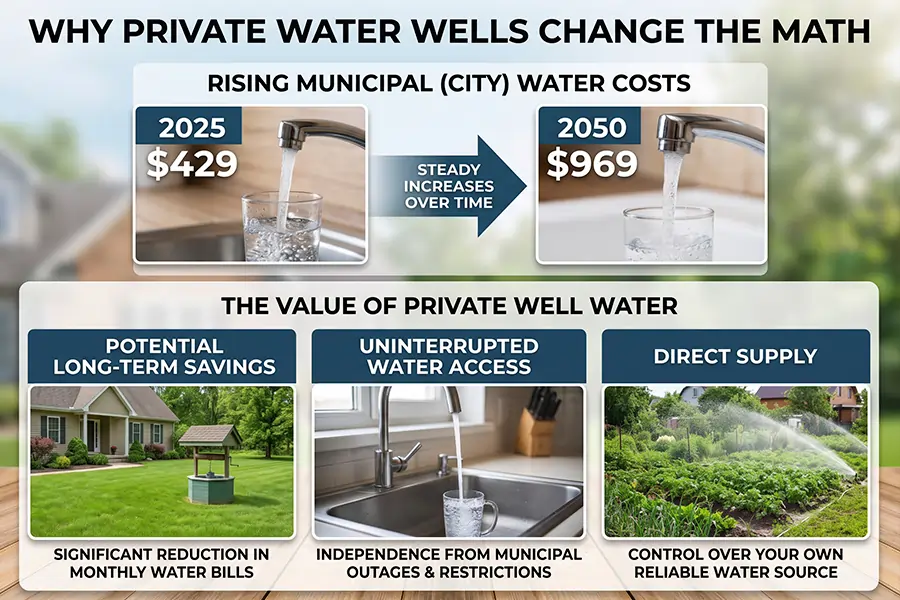
The core advantage of private water wells lies in the transition from a variable recurring cost to a fixed infrastructure investment. Once a well is drilled and the pumping system is installed, the primary ongoing expenses are the electricity required to run the pump and routine mechanical maintenance. You are no longer subject to municipal rate hikes driven by distant infrastructure failures or administrative overhead.
In the past, the primary deterrent to relying on private water wells was the risk of the unknown. Without visibility into the aquifer or the mechanical health of the pumping equipment, property owners faced the possibility of unexpected pump failures, dry tanks, or undetected leaks. These surprises could result in costly emergency service calls and significant operational downtime. Today, the integration of IoT technology and cellular telemetry fundamentally changes this equation. By applying industrial-grade monitoring to private groundwater systems, operators can achieve the same level of reliability as a municipal connection while maintaining complete financial independence.
A Rural Property Decision
To illustrate this shift, we can look at a recent scenario in the Texas Hill Country. A property owner developing a multi-structure agricultural and residential site faced a critical infrastructure decision. The property was located two miles from the nearest municipal water main. The owner had to choose between paying a substantial connection fee to trench a line to the municipal system or investing the capital into drilling a well on the property.
The municipal utility provided a quote that included the cost of trenching through rocky terrain, installing a commercial-grade meter, and a monthly base rate that would be subject to annual increases. Furthermore, the property’s projected water usage for irrigation and livestock would place them in the highest tier of the utility’s pricing structure, resulting in steep monthly bills.
Evaluating Initial Infrastructure Costs
The initial capital expenditure for the municipal connection was estimated at $45,000, primarily driven by the labor and equipment required for trenching. In contrast, the quote for drilling a well, installing casing, setting a submersible pump, and erecting a storage tank with a booster pump came to $38,000. On a purely upfront basis, the well presented a $7,000 savings. However, the property owner was initially hesitant, citing concerns about the long-term reliability of private water wells and the potential for undetected equipment failure.
Factoring in Long-Term Operational Expenses
The financial modeling for the next twenty-five years heavily favored the well. The municipal rates, projected to double by 2050, would cost the property owner an estimated $120,000 in water bills over that period, assuming conservative usage. The operational cost of the well consisted only of the electricity to power the pump cycles and scheduled maintenance. To mitigate the risk of unexpected mechanical failures and ensure the long-term viability of the investment, the owner decided to allocate a portion of the initial savings toward advanced water well telemetry solutions.
Securing Private Water Wells with Telemetry
To protect the infrastructure investment, the property owner partnered with their driller to install a comprehensive monitoring system. We understand that the true value of private water wells is only realized when the system operates efficiently and predictably. The installation included cellular connectivity modules and Modbus sensors integrated directly into the wellhead and storage tanks.
This hardware configuration provided real-time visibility into several critical metrics. First, the system monitored the static and pumping water levels, allowing the owner to track drawdown during heavy usage periods. Second, the telemetry unit recorded precise pump cycles and run times. Third, ultrasonic sensors provided continuous readouts of the storage tank levels. By digitizing these metrics, the property owner transformed a passive hole in the ground into an actively managed utility.
Proactive Management and Alert Systems
The true return on investment for remote groundwater monitoring hardware comes from proactive management. Six months after installation, the telemetry system detected an anomaly. The booster pump began short-cycling, turning on and off rapidly during the night when water usage should have been zero. The system immediately dispatched a text alert to the property owner and the designated well service company.
A quick inspection revealed a failed check valve in the irrigation system that was causing a slow leak, forcing the pump to continuously repressurize the line. Because the issue was caught within hours, the owner avoided burning out the booster pump motor and prevented thousands of gallons of water waste. Without telemetry, this issue would likely have gone unnoticed until the pump failed completely, resulting in a costly emergency replacement and days of downtime.
Financial and Operational Independence
By choosing to drill a well and secure it with modern IoT technology, the Texas Hill Country property owner achieved both financial predictability and operational independence. The total cost of ownership for the well, including the initial drilling, the telemetry hardware, and ongoing electricity, is projected to remain flat over the next two decades. The property is entirely insulated from the municipal rate hikes that are expected to double by 2050.
Furthermore, the data provided by the monitoring system empowers the owner to make informed decisions about water usage, ensuring the long-term sustainability of the aquifer. This case study demonstrates that private water wells are no longer a gamble. When supported by proactive water infrastructure management, they are a highly engineered, reliable solution that directly combats the rising costs of municipal utilities.
Frequently Asked Questions
How do private water wells compare to municipal water costs over time?
While the initial cost of drilling a well can be significant, the long-term operational costs are generally limited to electricity and routine maintenance. As municipal water rates are projected to double by 2050 due to aging infrastructure and treatment costs, private water wells offer a fixed-cost alternative that protects property owners from escalating monthly bills.
What role does telemetry play in managing private water wells?
Telemetry systems utilize cellular connectivity and sensors to transmit real-time data about your well system. This includes tracking pump cycles, monitoring drawdown, and measuring tank levels. This data allows operators to transition from reactive repairs to proactive maintenance, significantly reducing downtime and extending the lifespan of the pumping equipment.
How can I monitor my well system remotely?
Remote monitoring is achieved by installing specialized hardware at the well site, which communicates with cloud-based software. Property owners and utility managers can access this data through platforms like the NightOwl Monitoring dashboard and control systems. This provides instant visibility into system health and delivers automated alerts if operational anomalies, such as pump short-cycling or low tank levels, are detected.
The trajectory of municipal water costs is clear. By investing in independent groundwater infrastructure and securing it with reliable telemetry, you take control of your water supply and your financial future. We are committed to providing the tools and insights necessary to make that independence a practical, everyday reality.