
 ChatGPT
 Perplexity
 Claude
 Gemini
 Grok
Grok
Water wells can be anywhere from 25 feet to over 1,000 feet deep depending on where you are, what geology sits beneath your property, and what the water will be used for. There is no universal depth that applies everywhere. The USGS, in a national analysis of domestic water supply wells, found a median depth of 142 feet across all domestic-supply wells in the United States. Most residential wells fall somewhere between 100 and 500 feet, though plenty fall outside that range in both directions.
At NightOwl Monitoring, we work alongside well drillers and private well owners every day, and well depth comes up constantly as a factor in pump selection, drawdown behavior, and how a system holds up over time. This guide covers everything: average well depths, how shallow and deep wells differ, what depth means for drinking water safety, how depth varies by region and geology, and what questions to ask before any well is drilled.
Key Takeaways
- The USGS-reported median depth for domestic water supply wells in the US is 142 feet. Most residential wells fall between 100 and 500 feet.
- Shallow wells are typically under 50 feet deep and draw from unconfined near-surface aquifers. They cost less to drill but are more vulnerable to contamination and seasonal drying.
- Deep wells generally exceed 100 feet and access confined aquifers with more stable, better-protected water. They cost more to drill but typically provide better long-term reliability.
- Well depth is determined by local geology, water table depth, seasonal fluctuation, water demand, and water quality requirements. No two properties are exactly alike.
- Drillers typically go 20 to 50 feet below the static water level to ensure adequate water during seasonal drawdown periods.
- Deeper does not always mean better water quality. Mineral content, dissolved solids, and naturally occurring contaminants like arsenic and radium can actually increase at greater depths in some formations.
- Knowing your well depth is essential for pump selection, replacement planning, and interpreting any changes in water level or system performance.
What Determines How Deep a Water Well Is?
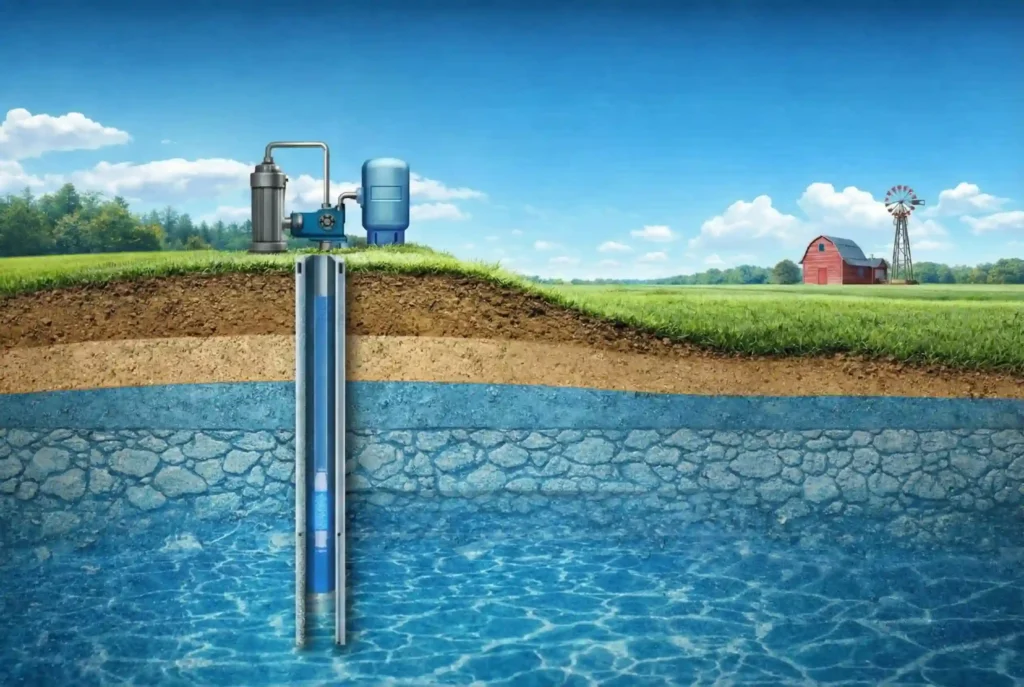
Well depth is not chosen arbitrarily. It is driven by a set of site-specific conditions that interact with each other, and an experienced local driller reads all of them before recommending a target depth.
The Water Table
The water table is the underground level below which the soil and rock are saturated with groundwater. It is not a fixed flat line; it rises and falls seasonally, follows terrain to some degree, and responds to rainfall and nearby pumping. A driller does not simply target the top of the water table. The standard practice is to drill 20 to 50 feet below the static (non-pumping) water level to ensure there is enough water column to sustain drawdown during extended pumping without pulling air.
Geology and Aquifer Type
The single biggest driver of well depth is the local geology. Permeable formations like sand, gravel, and fractured limestone allow water to move freely and can yield productive wells at shallower depths. Dense clay, solid granite, and tight shale require drilling deeper to reach zones where water can actually flow into the borehole. The type of aquifer matters too. Unconfined aquifers sit just below the water table with no impermeable cap layer; these are typically shallower. Confined aquifers are sandwiched between layers of impermeable rock and are under pressure; these require drilling through the cap layer to access, which adds depth but often yields more consistent supply.
Water Quality Requirements
Deeper wells generally sit farther from surface contamination sources including agricultural runoff, septic system leachate, road salt, and stormwater. Many state codes specify minimum depths for potable water wells partly for this reason. However, depth is not a guarantee of quality. Some deeper formations contain naturally elevated levels of arsenic, manganese, radium, or other minerals that require treatment regardless of depth. Water testing is always necessary, regardless of how deep the well goes.
Demand and Yield
A household with modest water use may do fine with a well that produces 3 to 5 gallons per minute. A farm with irrigation needs, livestock, and a residence on the same well may need to drill deeper to reach an aquifer zone capable of producing 15 to 20 GPM or more. When shallow formations cannot deliver the required yield, going deeper is the solution.
Seasonal Fluctuation
In areas where the shallow water table drops significantly during summer drought, a well that was productive in spring may run dry by August if it was only drilled to the seasonal high. Understanding local water table behavior across the full year is part of responsible well siting. State geological surveys and county well logs showing performance across seasons are the best local reference.
Average Water Well Depth in the United States
A USGS national analysis of domestic supply wells found a median depth of 142 feet across all domestic wells in the country. That figure tells the most accurate national story, but the range around it is wide.
| Well Category | Typical Depth Range |
|---|---|
| Shallow well | 25 to 50 feet (sometimes to 100 feet) |
| Moderate-depth residential well | 100 to 300 feet |
| Deep residential well | 300 to 500 feet |
| Very deep or commercial well | 500 to 1,000+ feet |
Most new residential wells drilled by professional contractors fall between 100 and 400 feet. Anything under 50 feet is generally considered a shallow well with associated risks around contamination and seasonal drying. Wells exceeding 500 feet typically indicate difficult geology, a deep aquifer, or a demanding yield requirement.
Shallow Well vs. Deep Well: What Is the Actual Difference?
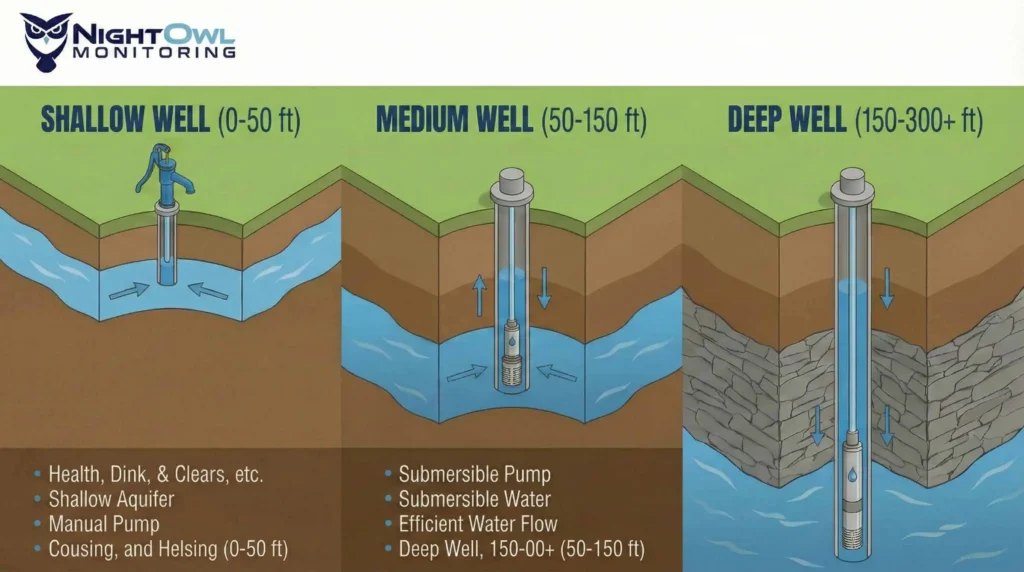
The 50-foot mark is the conventional dividing line in most professional references, though in practice the terms are used more loosely.
Shallow Wells (under 50 feet, sometimes to 100 feet)
Shallow wells draw from unconfined aquifers, the water-bearing zones closest to the surface. These wells were historically the most common type and are still used in areas with high, consistent water tables.
Where they work: Sandy coastal plains, areas with naturally high water tables, regions with thick permeable deposits near the surface, and low-demand applications like irrigation or seasonal cabins.
The trade-offs:
- Lower drilling cost
- Faster to install
- More vulnerable to surface contamination (bacteria, nitrates, pesticides, runoff)
- More sensitive to seasonal water table drops and drought
- Require more frequent water testing
- Generally not suitable for household drinking water in areas with agricultural activity, dense development, or shallow septic systems
Deep Wells (100 feet and beyond)
Deep wells access confined aquifers or deeper unconfined zones that are better protected from surface influences. The water has typically traveled a longer underground path, providing natural filtration through soil and rock.
Where they are necessary: Rocky or arid regions, areas where the shallow water table is unreliable or contaminated, high-demand applications, and most full-time residential use in areas with any agricultural or industrial activity nearby.
The trade-offs:
- Higher drilling cost (roughly $15 to $30 per foot depending on region and formation)
- Requires more powerful pumps for greater lift
- More stable and reliable supply year-round
- Lower risk of surface contamination reaching the water
- May encounter naturally occurring minerals at depth that require treatment
How Deep Should a Well Be for Drinking Water?
For potable drinking water, most states and well professionals recommend a minimum of 100 feet, and many recommend deeper still depending on local conditions. The general standard from the US EPA and most state programs is that a well should be deep enough to:
- Reach a reliable aquifer that holds water year-round
- Be below any zone where surface contamination is likely to reach
- Provide enough water column above the pump intake to sustain household demand during drawdown
In practice, a well drilled to 100 to 150 feet in a sandy coastal area may have similar contamination protection to one drilled to 300 feet in a region with tight clay layers that naturally block surface water migration. Geology determines the effective protection as much as raw depth does.
One thing depth cannot do on its own is guarantee water safety. A deep well in a formation with naturally high arsenic or manganese will still require treatment. Annual water testing is the only reliable way to confirm what is in your water regardless of how deep the well goes.
How Deep Are Water Wells by Region?
Well depth varies more by geography than almost any other factor. Here is a realistic regional breakdown based on geology, aquifer type, and drilling records.
| Region | Typical Residential Depth | Notes |
|---|---|---|
| Florida | 40 to 300 feet | Surficial and Biscayne Aquifer wells: 40 to 100 feet. Floridan Aquifer wells: 150 to 300 feet. Karst geology allows relatively shallow access in many areas. |
| Texas | 100 to 800+ feet | Ogallala Aquifer (Panhandle): 150 to 400 feet. Edwards Aquifer (Hill Country): 400 to 800 feet. Gulf Coast: 100 to 500 feet. Trans-Pecos: often 600 to 1,000+ feet. |
| Midwest (IL, IA, OH, IN) | 100 to 300 feet | Productive glacial and sedimentary aquifers. Generally moderate depths with stable supply. |
| Great Plains | 150 to 500 feet | Ogallala and other deep alluvial aquifers. Declining water levels in heavily irrigated areas require deeper drilling over time. |
| Northeast (NY, VT, PA, NH) | 100 to 400 feet | Fractured bedrock aquifers are common. Wells in permeable glacial sediment can be shallower; rock wells often 200 to 400 feet. |
| Southeast (GA, NC, SC) | 100 to 400 feet | Sandy soils allow fast percolation; moderate aquifer depths typical for residential wells. |
| Mountain West (CO, UT, NM) | 200 to 800+ feet | Complex geology and arid conditions often require deeper drilling. Alluvial basins vary significantly. |
| Pacific Northwest (WA, OR) | 100 to 500 feet | Volcanic geology and glacial deposits create variable conditions. Many productive wells in the 150 to 300-foot range in lowland valleys. |
These are general ranges. Within any region, a specific property can vary significantly from the typical. The USGS National Water Information System and state geological survey databases contain well log records that give the best local depth data for a specific county or township.
What Is Considered a Deep Well?
In most professional and regulatory contexts, a deep well is any well that exceeds 100 feet in depth. Below that threshold, a well is generally considered shallow for regulatory and classification purposes, though the informal distinction is more nuanced.
A well that reaches 150 feet in a sandy coastal setting where the water table sits at 10 feet is technically “deep” by the 100-foot standard but is accessing relatively near-surface water compared to a well at 150 feet in bedrock country where the water table sits at 130 feet. What matters functionally is how far below the static water level the screen or open interval sits, not the total casing depth alone.
How Deep Do You Have to Dig to Find Water?
The answer depends entirely on where you are. In areas with shallow water tables like coastal Florida, the water table can be within a few feet of the surface in wet periods, though a productive well still needs to go deeper for reliable year-round supply. In arid West Texas hill country, finding useful water may require drilling 600 feet or more.
The only reliable way to estimate the depth needed on a specific property is to consult local well logs (filed with state agencies when wells are permitted and drilled), talk to a licensed local driller familiar with area geology, or review USGS groundwater data for the county.
There is no rule that says “dig X feet and you will find water.” Geology determines everything.
How to Find Out How Deep Your Well Is
If you already have a well and do not know its depth, several methods work:
Check the original well record. When a well is drilled by a licensed contractor, a completion report is typically filed with the state. These records include total depth, casing diameter, static water level, and yield. Your state’s water resource or environmental agency maintains these records, and many are searchable online by address.
Measure with a well sounder or weighted tape. A well depth sounder (also called an electric water level indicator or e-tape) is lowered into the casing to measure both total well depth and current static water level. This is the most accurate field method.
Contact the original drilling company. If you know who drilled the well, they may have job records.
Ask a licensed well contractor to inspect it. A professional inspection can determine current static water level, pump depth, and usable water column, all of which matter as much as total well depth for system planning.
Knowing your well depth matters practically because it determines the right pump size and setting depth, informs replacement planning, and provides context for interpreting any changes in water level over time. Understanding why monitoring and measuring well water levels matters is part of getting the most out of that data once you have it.
Does Deeper Always Mean Better Water Quality?
Not necessarily. Depth improves protection from surface-derived contamination, but it introduces different water quality considerations.
Improvements from greater depth:
- Better protection from agricultural runoff, septic contamination, and stormwater
- Water has traveled through more rock and soil, providing natural filtration
- More stable temperature and chemistry
Potential issues at greater depth:
- Elevated arsenic in certain geological formations (a naturally occurring element in many rock types)
- Higher manganese and iron concentrations from deep mineral-rich rock
- Elevated total dissolved solids (TDS) in some arid basin formations
- Naturally occurring radium in certain deep bedrock wells
The only way to know what is actually in your water at any depth is to test it. Annual testing for bacteria, nitrates, pH, and a full mineral panel every three to five years is the standard for any private well used for drinking water.
Can a Well Be Deepened?
In some situations, yes. Well deepening involves extending the existing borehole further into the ground to reach a deeper, more productive aquifer. It is a reasonable option when:
- The existing casing is structurally intact and in good condition
- The current yield has declined due to a dropping water table
- Local geology suggests a more productive zone exists at greater depth
- The cost of deepening is less than drilling a new well
Well deepening is not always possible. If the existing casing is corroded, if the borehole is obstructed, or if local geology makes further drilling impractical, a new well at a different location may be the better path. A licensed well contractor can assess feasibility before any work begins.
How Well Depth Affects Pump Selection and System Performance
Well depth directly determines what pump is appropriate, how the system is configured, and what to expect in terms of performance over time.
Shallow wells (under 25 feet to water): A shallow well jet pump mounted above ground can work. These pumps rely on atmospheric pressure to lift water and are limited to approximately 20 to 25 feet of vertical lift under real-world conditions.
Wells 25 to 50 feet: A convertible jet pump or a small submersible pump becomes necessary.
Wells 50 feet and beyond: A submersible pump set inside the well casing at or below the static water level is the standard approach. The pump pushes water up rather than pulling it, removing the atmospheric pressure constraint on depth.
The pump must be set below the pumping water level, not just the static water level. When the pump runs, the water level inside the casing drops (drawdown). If the pump intake is not deep enough below the pumping level, it will pull air, lose prime, and potentially run dry, which damages the motor and seals. This is why knowing both static water level and yield (how fast the well recovers) matters as much as total well depth when sizing a pump.
If you are experiencing pressure problems or suspect pump issues related to water level, the overview on what causes low water pressure on a well covers the most common diagnostic paths.
Signs Your Well Depth May Be Causing Problems
Some performance issues in a well system are directly related to how the well interacts with the water table at its current depth. Watch for these:
- Pump runs longer than usual to reach pressure: May indicate the water level has dropped and the pump is working harder to lift water from a greater distance.
- Air in the water lines or sputtering at faucets: The pump may be drawing the water level below the intake, pulling air instead of water.
- Seasonal loss of pressure or low flow in late summer: A shallow well or a pump set too high for current water table conditions.
- Sand or sediment in water: The pump intake may be too close to the bottom of the well, or the water table has dropped enough that the pump is drawing from a sediment-rich zone.
- Well goes dry during drought: Typically a shallow water table issue; deepening the well or resetting the pump lower may help.
These patterns are much easier to diagnose when you have historical data on water levels and pump behavior over time. For well owners and drilling contractors who want to track these trends, NightOwl Monitoring’s approach to pump efficiency monitoring explains how runtime, pressure, and cycling data reveal what a static inspection cannot.
How Much Does Well Depth Add to Drilling Cost?
Drilling cost increases with depth, though the rate varies by geology, region, and rig type. As a general reference across the United States:
- Drilling cost: Roughly $15 to $30 per foot for typical residential wells in accessible terrain. Hard rock drilling in mountain or bedrock regions can run $30 to $60 per foot or more.
- Casing cost: Steel or PVC casing is priced per foot and adds to total cost proportionally with depth.
- Pump and electrical: Deeper wells require more powerful pumps and longer drop pipe and wire runs, adding to the installation cost.
A 200-foot well in moderate soil might cost $8,000 to $15,000 total installed. A 500-foot well in hard rock could run $20,000 to $35,000 or more. These are approximate ranges; actual costs depend heavily on local labor rates, permitting, and site conditions. For a more detailed breakdown of what drives the total price, the guide on how much it costs to drill a water well covers the full cost picture.
How NightOwl Monitoring Connects to Well Depth Performance
Well depth sets the physical parameters of a system at the time of drilling. But aquifer levels are not static. Water tables change with drought, seasonal recharge, and long-term trends in regional groundwater use. A well drilled to an adequate depth in 2005 may be sitting on a declining aquifer by 2026 in some regions.
Tracking what happens to water levels inside the well over time is the only way to know whether depth that was once sufficient is becoming marginal. NightOwl Monitoring systems measure real-time water level, pump runtime, and pressure behavior continuously. Patterns that point to declining water table, increased drawdown, or a pump working at the edge of its lift capacity all show up in the data before they become emergency failures.
For well drilling contractors, this data also helps answer the questions homeowners ask about depth: whether their current well is performing as expected for its depth and local geology, whether seasonal declines are within normal range, and whether a pump setting adjustment or well deepening conversation should happen proactively rather than after a failure. Find out more about the problems NightOwl monitoring is built to prevent at the NightOwl Loaner Program page, which gives contractors a hands-on way to evaluate the system.
Frequently Asked Questions
How deep are water wells on average?
According to a USGS national analysis, the median depth for domestic water supply wells in the United States is 142 feet. Most residential wells fall between 100 and 500 feet, though regional geology drives significant variation in both directions.
What is the average depth of a well for a house?
Most residential drinking water wells in the US are drilled between 100 and 300 feet. In regions with deep or difficult geology such as West Texas hill country, New Mexico, or mountain states, residential wells commonly exceed 400 to 600 feet.
How deep is a shallow well?
A shallow well is generally defined as one drawing from a depth of 50 feet or less, though some references extend the category to 100 feet. Shallow wells tap unconfined near-surface aquifers and are more susceptible to contamination and seasonal water table drops than deep wells.
How deep is a deep well?
A deep well typically exceeds 100 feet in depth and accesses confined or deeper unconfined aquifers. Most deep residential wells fall between 100 and 500 feet. Wells beyond 500 feet are common in arid, rocky, or geologically complex regions.
What is the difference between a shallow well and a deep well?
The primary difference is which aquifer they access and the level of protection from surface contamination. Shallow wells draw from near-surface unconfined water, which recharges more quickly but is more exposed to contamination and seasonal variability. Deep wells access confined or deeper unconfined aquifers with more stable supply, better natural filtration from overlying rock and soil, and less vulnerability to surface events.
How deep do you have to dig to find water?
It depends entirely on local geology and water table depth. In parts of coastal Florida, the water table can be within a few feet of the surface. In arid West Texas or mountain regions, you may need to drill 600 to 1,000 feet. Consulting local well records and a licensed local driller is the only reliable way to estimate depth for a specific property.
Is a deeper well always better?
Not automatically. Deeper wells generally provide more stable supply and better protection from surface contamination, but they cost more to drill and can encounter naturally occurring minerals that require treatment. The right depth is the one that reaches a reliable aquifer with adequate yield for the intended use, not necessarily the deepest possible.
How deep is groundwater?
Groundwater depth varies from nearly at the surface in wetlands and coastal lowlands to thousands of feet in deep sedimentary basins. The usable domestic water supply typically sits between 50 and 500 feet in most of the US, though productive confined aquifers exist at much greater depths in some regions.
Final Takeaway
Water well depth is one of the most geography-specific questions in the residential water supply world. The USGS median of 142 feet for domestic wells gives a useful national reference point, but the realistic range runs from 25-foot driven wells in high water table areas to 1,000-foot boreholes in hard rock and arid regions.
Depth influences contamination protection, seasonal reliability, pump selection, and long-term system behavior. It is determined at the time of drilling based on local geology, water table data, demand requirements, and water quality goals. No general average substitutes for local well records and the judgment of an experienced driller who knows the formation under your specific property.
What depth cannot do is permanently guarantee a well’s performance. Aquifer levels shift over time, and a well that was more than adequate when drilled can become marginal during drought years or as regional groundwater use increases. Tracking those changes with real-time water level and pump performance data is how modern well owners stay ahead of the problem.