

 ChatGPT
 Perplexity
 Claude
 Gemini
 Grok
Grok
Turning on your tap and seeing brown well water come out is one of those moments that stops you cold. Whether your well water turned brown overnight, started running murky after a heavy storm, or has slowly darkened over time, the same questions hit every private well owner: Is it safe? What caused it? And how do I fix it?
Here is the short answer: brown well water is most commonly caused by iron, manganese, sediment, tannins, or surface water intrusion. Most cases are fixable once you identify the source. Some are minor. A few are urgent. This guide walks you through every cause, a quick self-diagnosis method, and exactly how to clear up brown well water for good, whether the issue started today or keeps coming back.
At NightOwl Monitoring,You will see how we helps well owners catch the hidden system changes (pressure drops, unusual pump cycling, falling water levels) that often trigger a brown water event before discolored water ever reaches the faucet.
Key Takeaways
- Brown water is caused by iron, manganese, sediment, tannins, or surface water intrusion.
- Safety depends on the cause, not the color of the water.
- Test the water before drinking it. Color alone cannot confirm safety.
- Sediment clears in hours. Iron and manganese do not clear on their own.
- Hot water brown but cold water clear points to the water heater.
- Recurring brown water means a structural or mechanical well issue.
- Flushing helps sediment. Treatment systems fix iron, manganese, and tannins.
- Monitoring catches pressure drops and water level changes before water turns brown.
Why Is My Well Water Brown? 9 Causes Explained
Brown water is always a signal that something changed in the well system, the plumbing, or the groundwater itself. The specific cause determines the right fix, so identifying it first is the most important step.
1. Iron and Iron Bacteria
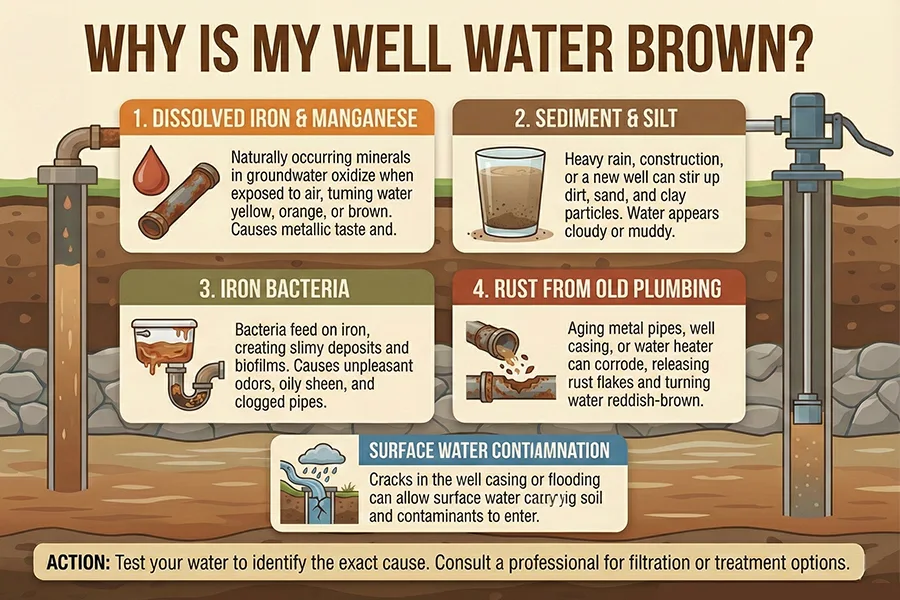
Iron is one of the most common causes of brown or rust-colored well water. According to the EPA’s secondary drinking water standard, iron above 0.3 mg/L (parts per million) causes visible discoloration, typically a yellow, orange, or reddish-brown color. When iron in groundwater is exposed to oxygen (either in the well, the pressure tank, or at the tap), it oxidizes and turns rust-colored.
Iron bacteria are a separate but related issue. These naturally occurring microorganisms combine iron and manganese with oxygen to form a reddish-brown slime or deposit. If you notice orange stringy material in a water sample jar or a slick biofilm coating on fixtures, iron bacteria may be present alongside dissolved iron.
2. Manganese
Manganese often occurs alongside iron but produces a darker discoloration, from dark brown to nearly black. The EPA has set a health advisory for manganese in drinking water at 0.3 mg/L, with research suggesting that chronic exposure above this level may affect neurological development in infants and young children. If your well water is dark brown or has a black tint, manganese should be near the top of your suspect list.
3. Sediment and Silt
Sand, silt, clay, and fine particles enter the water supply when the well is disturbed, when the pump is set too close to the bottom of the well, or when the well screen is damaged or clogged. Sediment is a common cause of brown well water after heavy rain, after heavy water use, or after any work is done on the well system. It typically produces a muddy brown color with visible particles that settle at the bottom of a jar.
4. Tannins (Organic Matter)
Tannins are naturally occurring compounds that form when plant material (leaves, roots, organic soil) decays. Rainwater carries tannins into shallow aquifers and wells that lack proper casing depth or seal integrity. Tannin-discolored water looks tea-colored or yellowish-brown and, critically, does not clear when left to stand in a glass. The water remains uniformly tinted with no settling particles. Tannins are generally considered an aesthetic water-quality concern rather than a primary health concern, but testing can help confirm the cause of discoloration.
5. Surface Water Intrusion After Rain
If a well is not cased deep enough, if the wellhead cap is cracked or missing, or if the ground around the well is graded toward the casing instead of away from it, rainwater and runoff can infiltrate the well. This is one of the most serious causes of brown well water after heavy rain because surface water can carry bacteria, nitrates, pesticides, and other contaminants from the surrounding land directly into the water supply.
6. Plumbing or Well Casing Corrosion
Older galvanized steel pipes, aging well casings, or corroding pipe fittings release rust and dissolved metals into the water. If the brown water appears primarily after water has been sitting in the pipes overnight and then clears quickly when you run the tap, plumbing corrosion is a likely contributor.
7. Water Heater Rust
If brown water appears only from the hot tap, the water heater is usually the source rather than the well itself. Inside a water heater, a component called the anode rod sacrificially corrodes to protect the tank liner. When the anode rod is depleted, the tank itself begins to corrode, releasing rust-colored water. Sediment also accumulates at the bottom of the tank over years of use, creating a brown tint in hot water only.
8. Damaged Well Screen or Dislodged Pump
The well screen filters sediment at the intake. When it is corroded, broken, or partially blocked, sediment bypasses filtration and enters the supply line. A pump that has shifted or fallen too low can also draw water directly from the sediment layer at the well bottom, producing persistently murky water that does not clear with flushing.
9. Worn Water Softener Resin Beads
Water softeners use resin beads to capture hard minerals from the water. These beads typically last six to ten years. When they degrade, fragments enter the water supply and can cause a brown or yellowish tint. If your softener is aging and other causes have been ruled out, resin bead replacement is worth investigating.
What Color Is the Water? A Self-Diagnosis Guide
The color and behavior of your brown water are strong diagnostic clues before any lab test.
The Jar Test (Do This First)
Fill a clear glass jar from a cold tap. Observe the color and then let it sit undisturbed for 30 minutes.
- Grit or sand settles at the bottom: Sediment or a pump or well screen problem.
- Orange or rust-colored flakes appear: Oxidized ferric iron or pipe corrosion.
- Brown slime or stringy threads appear: Iron bacteria biofilm.
- Water stays uniformly tea-brown with no settling: Tannins or dissolved organic color.
- Water clears from the bottom up (clouds rise): Trapped air, typically harmless.
Reddish Brown or Orange
Points primarily to iron or rust. Check whether the color is stronger in hot water (water heater) or in cold water (well, pipes, or groundwater iron). Staining on toilet bowls, sinks, or laundry confirms an iron source.
Dark Brown or Black
Points to manganese, sometimes combined with iron or sediment. Black staining on toilet tanks, tubs, or laundry is a signature sign of manganese.
Yellow or Tea-Colored
Points to tannins or dissolved organic material. Tannins are most common in shallow wells, in areas with heavy organic soil, or after prolonged rainfall. Water looks like weak brewed tea and typically has a faintly earthy odor.
Brown and Cloudy with Visible Particles
Points to sediment, especially if the cloudiness appeared after heavy rain, heavy water use, or recent work on the well or plumbing. The particles indicate physical intrusion rather than dissolved minerals.
Is Brown Well Water Safe? Drink, Bathe, Shower
Brown well water safety depends entirely on the cause, not just the color.
Safe for bathing in most cases: If the brown color comes from iron, manganese, or sediment and has not followed flooding or a significant storm event, bathing is typically not harmful. However, iron and manganese water can stain skin, clothing, and fixtures, and it may irritate sensitive skin.
Not safe to drink without testing: Color alone cannot confirm safety. Brown water may look identical whether caused by harmless iron or by surface water contamination carrying E. coli or other bacteria. Until you have a water test result, use bottled water for drinking and cooking.
Stop using for any purpose if: the brown water started after flooding, carries a sewage or chemical odor, or is accompanied by sudden illness in the household. These situations require immediate water testing and professional inspection. Do not assume boiling solves the problem; boiling addresses microorganisms but does not remove iron, manganese, nitrates, or chemical contamination.
How Long Does Brown Well Water Take to Clear?
Clearing time depends almost entirely on the underlying cause:
- Temporary sediment disturbance (after heavy use or a storm): Usually clears within a few hours to one day of reduced pumping and light flushing.
- Iron or manganese: Does not clear on its own. Requires filtration or treatment to resolve.
- Tannins: Does not clear on its own. Requires an anion exchange or carbon filtration system.
- Surface water intrusion: Will not clear reliably until the entry point is sealed and the well may need shock chlorination.
- Damaged equipment (screen, pump, casing): Will not clear until repaired.
A useful rule: If brown water does not improve after reasonable flushing or continues returning, don’t assume it will resolve on its own. Persistent discoloration warrants further testing or inspection to identify the underlying cause.
What to Do Immediately When Well Water Turns Brown
When brown water appears, work through these five steps before doing anything else.
Step 1: Stop Using It for Drinking and Cooking
Switch to bottled water immediately, especially if the change is sudden or followed a storm or flood. This is the single most important step while you determine the cause.
Step 2: Run Cold Water From an Outdoor Spigot
Running an outdoor tap instead of indoor fixtures prevents heavy sediment from flowing through valves, aerators, and appliances. Run it for 10 to 20 minutes and watch whether the water improves, stays the same, or gets worse.
- Water clears after several minutes: Likely a temporary sediment disturbance. Continue flushing gently.
- Water stays brown or worsens: Stop flushing and investigate further. Continued pumping can pull more sediment into the system.
Step 3: Protect Your Appliances
Hold off on running the washing machine, dishwasher, and ice maker until the water clears. Sediment and iron can clog inlet valves, damage pump seals, and leave staining inside appliance drums that is very difficult to remove.
Step 4: Check and Replace Sediment Filters
A whole-house sediment filter that has become heavily loaded with rust or mud can actually restrict flow and worsen the appearance of water at taps. Check the filter housing. If the cartridge is visibly discolored, replace it and flush the line before drawing conclusions about whether the water has improved.
Step 5: Test the Water
At minimum, test for iron, manganese, total coliform, and E. coli, especially if the change followed heavy rain or flooding. Home test kits offer a basic starting point. A certified laboratory test is the only way to get results you can rely on for safety decisions. If you are unsure how to approach this, see the NightOwl guide on how to test well water for a step-by-step walkthrough.
How to Clear Up Brown Well Water Based on the Cause
If Brown Water Appeared After Heavy Rain
Brown well water after heavy rain almost always means the well is taking in surface water, runoff, or disturbed sediment from the aquifer. This scenario requires both immediate action and investigation to prevent recurrence.
What to do:
- Switch to bottled water for drinking and cooking until you have test results.
- Flush from an outdoor spigot for 15 to 20 minutes and observe whether the water clears.
- Inspect the wellhead. Look for pooling water near the casing, cracks in the cap, or ground that slopes toward the well.
- Replace or clean sediment filters.
- If water does not clear within a day, schedule a professional inspection and water test for bacteria.
If this happens repeatedly after rain events, the root fix is wellhead protection: a proper sanitary cap, correct grading to direct water away from the casing, and confirming the casing seal is intact. Filtering the symptom without fixing the pathway means your well remains vulnerable to contamination.
If Brown Water Appeared After Heavy Water Use
Pumping large volumes quickly drops the water level inside the well. When that level falls far enough, the pump draws water from near the bottom of the well, where sediment collects. This produces brown well water after heavy water use that typically improves once the well has time to recover.
What to do:
- Reduce demand for two to four hours and allow the well to recover.
- Flush gently from an outdoor spigot.
- Monitor whether the issue repeats under similar demand conditions.
If sediment appears every time water demand is high, the pump may be set too low in the well, the well yield may be insufficient for the household demand, or the well may need a screen inspection. Understanding well water level trends over time helps identify whether drawdown is the real driver.
If Brown Water Is Only in the Hot Tap
When hot water is brown but cold is clear, the problem is almost always the water heater rather than the well.
What to do:
- Flush the water heater tank. Turn off the heater, connect a hose to the drain valve at the base, and drain until the water runs clear.
- Inspect the anode rod. If it is heavily depleted or coated in black sludge, replace it.
- If discoloration keeps returning after flushing and anode rod replacement, the tank liner may be corroding internally. At that point, replacement is usually more cost-effective than continued repairs.
If Brown Water Is Only in the Cold Tap
Cold-only discoloration points to the well, the pressure system, or the plumbing before the water heater. Focus first on flushing and sediment filter inspection. If flushing does not clear the issue, the source is likely in the groundwater (iron, manganese, or sediment intrusion) and will require a water test to confirm before selecting the right treatment.
If Brown Water Keeps Coming Back
Recurring brown water is the most important pattern to take seriously. It tells you a filtering or flushing approach is treating the symptom rather than the cause. Common reasons for recurrence include:
- Groundwater iron or manganese levels high enough to continuously discolor without proper treatment
- Ongoing surface water infiltration through a damaged wellhead
- A pump set too low that continuously disturbs sediment
- A well yield that cannot meet household demand without repeated drawdown events
Recurring discoloration usually requires a professional well inspection combined with a comprehensive water test. That combination tells you what is in the water and what is happening structurally in the well system. Signs of well pump failure can sometimes precede recurring brown water, and catching those early helps prevent a larger problem.
Long-Term Fixes: Filtration and Treatment by Cause
Once you know the cause from a water test, the right treatment becomes clear. Guessing at filtration without test data is the most common (and most expensive) mistake well owners make.
Sediment Filtration
A staged filter system handles sediment most effectively. A coarse pre-filter (20 to 50 micron) catches larger particles and protects a finer downstream filter (5 to 10 micron) from rapid clogging. According to water quality professionals, the right micron rating for your well depends on particle size analysis from a water test. A filter that is too fine for your sediment load will require cartridge changes far too frequently. See the NightOwl guide on what micron filter is best for well water for specific guidance on selecting the right stage setup.
Iron and Manganese Treatment
The correct iron treatment depends on the form of iron present:
- Ferrous (dissolved) iron: Water looks clear when drawn but turns brown on exposure to air. An iron filter with oxidation, a water softener (for low iron levels below 2 to 3 ppm), or a greensand filter can address this.
- Ferric (oxidized) iron: Visible orange or rust particles already present. A sediment filter catches this, but a whole-house iron filter is more effective for higher concentrations.
- Iron bacteria: Requires shock chlorination of the well to kill the bacteria, followed by ongoing iron filtration. Bacteria alone will recolonize a filter if the source is not disinfected first.
For manganese, oxidation filtration (such as a manganese greensand or birm filter) is the standard approach.
Tannin Removal
Tannins respond poorly to sediment filters. An anion exchange filter specifically designed for organic removal, or an activated carbon filter, targets tannins effectively. Because tannins vary significantly by water source, a water test that specifically measures tannins is the right starting point.
Wellhead Protection
For recurring brown water that follows rain events, the long-term fix is structural. A proper sanitary well cap, correct grading around the wellhead (ground sloping away from the casing), and casing inspection to confirm seal integrity are the investments that prevent rainwater pathways into the well. Filters cannot substitute for a compromised wellhead.
Will Brown Well Water Damage My Appliances?
This question is worth addressing directly because many homeowners focus only on water safety and underestimate the cost of equipment damage.
Yes, brown well water can significantly shorten appliance life. Specifically:
- Water heaters: Iron and sediment accelerate tank corrosion and reduce heating efficiency. Sediment buildup at the base of the tank reduces capacity and increases energy use.
- Washing machines: Iron stains drum interiors and discolors light-colored laundry permanently. Sediment wears out inlet valve seals.
- Dishwashers: Hard sediment and iron clog spray arms and etches glassware over time.
- Ice makers and refrigerator filters: Fine sediment clogs supply lines and inline filters rapidly.
Protecting appliances is a practical reason to address brown water promptly, even if the safety risk in your specific case turns out to be low. Water treatment that stops iron and sediment at the point of entry pays for itself in extended appliance life.
When to Call a Well Professional
Some situations call for a professional well driller or pump contractor rather than a DIY fix:
- Brown water does not clear after flushing and filter replacement
- Discoloration follows flooding or heavy storms and does not resolve within 24 hours
- Water carries a sewage, fuel, or chemical odor alongside the brown color
- You notice sputtering air in the lines, pressure drops, or the pump is running longer than usual
- Bacteria are detected in water testing
- Brown water keeps returning after you have already addressed filters and flushing
These patterns suggest a structural or mechanical problem in the well system, not just a water quality issue. Continued pumping against a damaged or compromised system accelerates wear on pumps, pressure tanks, and valves, making a professional evaluation sooner less expensive than later.
How Monitoring Prevents Brown Water Surprises
Most brown water events do not arrive without warning. Before the water turns brown, the well system often sends subtle signals: pressure behavior shifts, the pump runs longer than usual, water levels trend lower than normal, or the pump cycles more frequently under standard demand.
The problem is that most well owners have no way to see these patterns until the water already looks wrong.
NightOwl Monitoring tracks the real-time data points that precede discoloration events:
- Pressure trends that indicate leaks, restrictions, or changes in the supply
- Pump runtime and cycling patterns that show when the pump is working harder than normal
- Water level data that reveals drawdown events that stir sediment before it reaches the tap
- Automated alerts when readings move outside the normal operating window
For well owners who have experienced recurring brown water, adding continuous well monitoring means you know when the conditions that triggered it last time are forming again, before the water turns. That context turns a reactive problem into a manageable one.
Learning why monitoring and measuring well water levels matters is a good starting point for understanding what data can tell you that a visual check of your water cannot.
Frequently Asked Questions
Why is my well water brown all of a sudden?
Well water turns brown suddenly most often because of sediment disturbed by heavy rain, drawdown from high water use, a change in pump behavior, or a mechanical issue in the well system. If the change follows a flood or storm, test for bacteria before using the water for any purpose. If no obvious trigger explains the sudden change, a professional well inspection is warranted.
Why does my well water turn brown after sitting?
Well water containing dissolved iron can appear clear when first drawn and turn yellow, orange, or brown after exposure to air. This happens because dissolved iron oxidizes and forms visible particles. If this happens consistently, a water test can help determine the iron concentration and the appropriate treatment.
How do I know if brown well water is safe?
Color alone cannot tell you. Iron, manganese, sediment, and tannins are generally not health hazards at typical well water concentrations, but brown water caused by surface water intrusion or bacterial contamination looks similar and is not safe. A water test covering iron, manganese, total coliform, and E. coli is the only way to confirm safety.
How long does it take to fix brown well water?
Temporary sediment disturbance often clears within a day with reduced pumping and light flushing. Iron, manganese, and tannins require treatment systems that may take one to three days to install. Structural issues such as a damaged well screen, compromised wellhead, or dislodged pump require professional repair that, including retesting, typically takes one to two weeks.
Can I shower or bathe in brown well water?
In most cases of iron or sediment discoloration not associated with flooding, bathing is not harmful. However, brown water that followed flooding, carries an unusual odor, or has not been tested should be avoided for bathing until the cause is confirmed. Iron-heavy water can also stain hair and skin temporarily.
Does brown well water mean my well is contaminated?
Not necessarily. Contamination implies the presence of harmful pathogens or chemical pollutants. Many cases of brown well water involve purely aesthetic issues like iron staining or harmless sediment. However, contamination and discoloration can coexist, which is why testing is the definitive answer and not something to skip based on what the water looks like.
Final Takeaway
If you are asking how to clear up brown well water, the answer starts with diagnosis, not filtration. Identify whether the cause is iron, manganese, sediment, tannins, surface water intrusion, or a mechanical issue. Match the treatment to the actual cause. Then address the source so the problem does not return.
For recurring brown water, the pattern matters as much as the color. Monitoring the well system for pressure, pump behavior, and water level trends gives you the early warning that most well owners never get until the water is already discolored.
If you need help diagnosing an ongoing brown water issue or want to understand what your well system data can tell you, NightOwl Monitoring works with well owners and drilling contractors to build a clearer picture of what is happening underground.