 ChatGPT
 Perplexity
 Claude
 Gemini
 Grok
Grok
Choosing the right water monitoring system is not about buying the model with the longest feature list. It is about matching the hardware to the job. A remote ranch water tank, an irrigation well, and a municipal pumping station all face different monitoring challenges, so the same solution rarely fits every site.
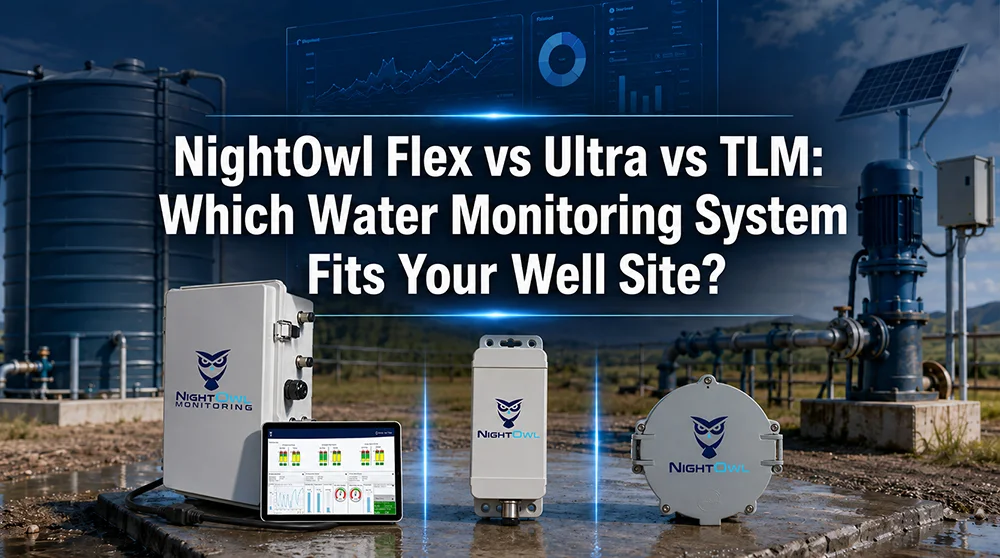
That is exactly why many operators compare NightOwl Flex vs Ultra vs TLM before investing in a monitoring system. While all three products connect to the same NightOwl cloud platform, they are designed for very different applications. One focuses on simple battery-powered tank monitoring, another delivers affordable multi-sensor well telemetry, and the third combines advanced monitoring with remote equipment control for critical infrastructure.
If you choose the wrong unit, you may end up paying for features you never use or, even worse, discover that your system cannot monitor the sensors or control the equipment your site actually depends on.
Which NightOwl System Is Right for You?
Here is the quick answer.
- Choose NightOwl TLM if you need a simple, battery-powered solution to monitor the water level in a single storage tank with minimal maintenance.
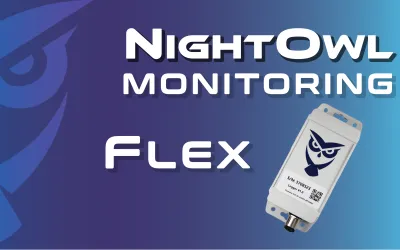
- Choose NightOwl Flex if you need reliable cellular well monitoring for up to three Modbus sensors and only want to monitor site conditions without remote control.
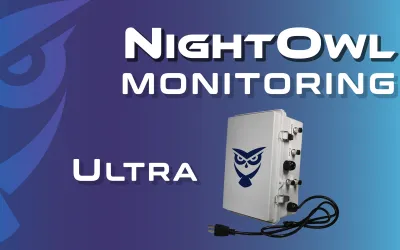
- Choose NightOwl Ultra if your operation requires multiple sensor types, advanced pump analytics, automated reporting, and relay outputs that allow you to remotely control equipment.
This guide compares NightOwl Flex vs Ultra vs TLM side by side, including sensor compatibility, reporting frequency, power requirements, installation complexity, remote control capabilities, and the types of well sites each system is built for. By the end, you’ll know exactly which NightOwl monitoring system best fits your application and budget.
NightOwl Flex vs Ultra vs TLM at a Glance
All three NightOwl systems feed the same cloud dashboard, which means the hardware decision is about what happens at the site, not about the software you log into afterward. The differences that matter are sensor support, how often data arrives, how the unit is powered, and whether the system can send a command back down the wire.
| Capability | NightOwl TLM | NightOwl Flex | NightOwl Ultra |
|---|---|---|---|
| Built for | Single-tank level monitoring | Multi-sensor well monitoring, monitoring only | Monitoring plus remote control |
| Sensor support | Integrated radar level sensor | Up to 3 Modbus RTU sensors | 2 analog (4-20mA), 4 digital/pulse, 8-port Modbus expansion |
| Control outputs | None | None | 2 ice cube relays, 7A rating |
| Power | Replaceable lithium battery | 12V DC | 120VAC with 24VDC internal supply |
| Enclosure | IP68, Cl1 Div1 Zone0 certified | Waterproof enclosure | NEMA 4X, UL Listed |
| Install difficulty | Lowest, under an hour typical | Moderate, basic electrical skills | Highest, certified technician |
| Multiple wells per unit | No | Yes | Yes |
| Best fit | Rural systems, residential tanks, bulk water delivery | Drillers and service companies adding telemetry at scale | Municipalities, industrial sites, critical infrastructure |
The pattern is deliberate. Each step up buys you either more sensor variety or the ability to act remotely, and each step down buys you a simpler install and a lower subscription cost.
The Question That Decides Everything: Monitoring Only or Monitoring Plus Control?
Monitoring-only systems report conditions, while control systems change them, and that single distinction eliminates two of the three products for most buyers before any other spec matters. The TLM and the Flex are both monitoring-only. Only the NightOwl Ultra carries relay outputs.
In practice, the test is simple. Ask what happens at 2 a.m. when the alarm fires. If the answer is “somebody drives out there,” monitoring-only is honest and sufficient, and you should spend the savings on better sensors. If the answer is “somebody needs to reset the pump, switch a valve, or cycle power before the tank runs dry,” you need relays, because an alert without an action is just a faster way to learn you already have a problem.
Relay-based operations change the economics of a service route more than any other single feature. A remote reset that prevents one emergency callout can pay for a meaningful chunk of the hardware, which is why the control relay capability in the Ultra tends to be the deciding factor for utilities running unmanned sites across a wide service area.
NightOwl TLM: Stand-Alone Tank Level Monitoring for One Site
The NightOwl TLM is a battery-powered radar tank level sensor that reports to the cloud on its own, without a panel, without site power, and without a separate controller. NightOwl’s published specification lists radar resolution up to 2mm across a measurement range of 3.2 inches to 22 feet, with an IP68 housing rated from -13°F to 122°F and Cl1 Div1 Zone0 certification for hazardous locations.
That certification matters more than most buyers expect. It is what allows the same unit to sit on a chemical feed tank or a fuel-adjacent installation where an unrated device is simply not allowed, which is why the TLM shows up so often in chemical feed tank alerting and bulk water delivery auto-fill programs.
Where the TLM Fits and Where It Stops
- Fits: one tank, one location, minimal maintenance, long deployment horizon
- Fits: hazardous or corrosive environments where a powered panel is impractical
- Fits: radar sensing that ignores dirt, buildup, and temperature swings that defeat float and ultrasonic sensors
- Stops: the TLM measures one thing. It cannot take on pressure, flow, power, or vibration sensors
- Stops: it is a single-site device. Monitoring several wells means several units, or a Flex or Ultra instead
- Stops: it takes readings hourly and publishes daily, so it is not the tool for catching a fast-developing fault
Battery life depends heavily on reporting frequency, temperature, and cellular signal quality at the site. The lithium cell is replaceable rather than sealed, so a marginal-signal installation does not turn into a hardware replacement. Our deeper walkthrough of storage tank level monitoring with the TLM covers mounting and configuration in detail.
NightOwl Flex: Cellular Well Monitoring on a Modbus Budget
The NightOwl Flex delivers frequent cellular well monitoring at a lower total cost than the Ultra because it does one thing deliberately: Modbus, up to three sensors, no relays. Data is collected every minute and uploaded every 15 minutes, which is roughly 96 times more frequent than the TLM’s daily publish.
The three-sensor limit is a pricing decision, not a technical ceiling. Capping sensor count caps the data volume, which caps the subscription cost your customer pays every month. For a well driller building a recurring revenue program across dozens of residential and agricultural sites, a monitoring package that customers renew without complaint beats a richer package they cancel after a year.
Why Modbus-Only Is the Right Trade for Most Wells
Modbus RTU over RS485 is the protocol most modern well sensors already speak, so restricting the Flex to it removes wiring ambiguity without removing much real capability. A typical three-sensor build covers the failure modes that generate the most service calls:
- A submersible or Modbus pressure transducer reading water level in the well to track drawdown and recovery
- A power monitor watching voltage and current for the electrical faults that kill motors
- A tank level or flow sensor confirming the system is actually delivering water downstream
That combination catches the majority of what shows up as early signs of well pump failure, which is the whole point of putting telemetry on a well in the first place.
Field Verification Before You Leave the Site
The Flex includes built-in Wi-Fi so the installer can pull up live sensor readings on a phone browser before packing up. Anyone who has driven back to a site because a sensor was reading zero understands why that feature exists, and it is a large part of why field-proven installation design matters more than headline specifications. Installation requires basic electrical skills for the 12V DC supply, enclosure mounting, and RS485 wiring, which puts it above the TLM in complexity and comfortably below the Ultra.
NightOwl Ultra: Full Monitoring and Control for Critical Sites
The Ultra is the only unit in the lineup that combines mixed sensor inputs, on-board analytics, and physical control outputs, which makes it the default choice wherever downtime carries a regulatory or financial penalty. It runs on 120VAC, ships pre-wired and panel-mounted in a NEMA 4X enclosure, and is UL Listed for North American installations.
Its I/O is what separates it from the Flex:
- Analog inputs: 2 channels, 0-20mA and 4-20mA current
- Digital inputs: 4 dry contact channels with pulse counting enabled on all four
- Modbus expansion: 1 x 8-port Modbus RTU
- Control outputs: 2 ice cube relays rated 7A (30V/5A, 250V/5A)
- Connectivity: 4G LTE across Verizon, AT&T, and T-Mobile, using MQTT and HTTPS
- Integration: REST API, CSV export, and SCADA connection via API or MQTT
The analytics layer is where the Ultra earns its keep on a municipal system. It logs at five-minute intervals by default and turns that stream into pump cycle counts, short-cycle detection, drawdown analysis, load profiling with power factor, and dry-run and cavitation indicators, then packages the result into automated weekly or monthly PDF reports. A district that has to demonstrate pumping behavior to a regulator gets that documentation as a byproduct of normal operation rather than as a separate reporting project.
Ultra also supports storage and chemical tank level monitoring alongside well-side sensors on the same panel, so one unit can cover both ends of a small water system.
Data Frequency and Power: The Two Specs Buyers Underestimate
Reporting interval determines which problems a monitoring system can catch, and power source determines where the system can physically go, so these two specifications constrain the decision more than sensor count does.
| Specification | NightOwl TLM | NightOwl Flex | NightOwl Ultra |
|---|---|---|---|
| Measurement interval | Hourly | Every minute | 5-minute logging (default) |
| Upload interval | Daily | Every 15 minutes | Scheduled and exception-based |
| Power source | Replaceable lithium battery | 12V DC | 120VAC, 24VDC internal |
| Site power required | No | Yes | Yes |
| Alerts | SMS, email, dashboard | SMS, email, dashboard | SMS, email, dashboard |
| Catches slow trends | Yes | Yes | Yes |
| Catches fast faults | No | Usually | Yes |
Read the table against the failure you are trying to prevent. A tank that drains over three days is caught by a daily report. A pump that short-cycles itself to death over an afternoon is not, and a dry-run event that burns a motor in twenty minutes needs five-minute logging plus a relay to interrupt it.
The power row is just as decisive. If the site has no reliable AC service, the Ultra is off the table regardless of how attractive its analytics are, and the choice narrows to a battery-powered TLM or a Flex on a small DC supply.
Tank Level Monitor vs Well Monitor: Which Problem Are You Solving?
A tank level monitor answers “how much water do we have,” while a well monitor answers “is the system that produces the water still healthy,” and confusing the two is the most common specification mistake we see.
A common scenario: a rural operator installs tank level monitoring, sleeps better for six months, then loses a pump anyway. The tank told them the level was falling. It could not tell them the motor was drawing abnormal current, the water level in the well had dropped past the intake, or the pump had started cycling every ninety seconds. Level was a symptom, and the diagnosis lived upstream.
If the asset you cannot afford to lose is the pump, monitor the pump. If the risk you are managing is running out of supply, monitor the tank. If both are true, the answer is either a Flex covering multiple points on one well or an Ultra covering the whole site. Our guide on how to monitor well water levels covers the sensor placement side of that decision.
How to Choose Your Water Monitoring System in Five Steps
Work through these in order. The first answer that rules out a product is the answer that matters, so stop as soon as a step eliminates an option.
- Confirm what you must be able to do remotely. If any answer involves starting, stopping, or resetting equipment, you need Ultra relays and the rest of the list is confirmation.
- Inventory the sensors your site already has or will get. All Modbus points to Flex or Ultra. Any 4-20mA analog or pulse output requires Ultra. A single tank level with no other sensors points to TLM.
- Check available power. No AC service means TLM or a Flex on 12V DC. Reliable 120VAC opens the full lineup.
- Match reporting frequency to your worst realistic failure. Slow-developing trends tolerate daily reporting. Anything that can damage equipment within hours needs 15-minute uploads at minimum.
- Price the subscription across the full fleet, not one unit. Sensor count drives recurring cost, so a Flex at three sensors across forty sites often produces a healthier program than an over-specified panel your customers cancel.
A useful sanity check on step five: it is easier to add a second unit later than to justify an over-built one now. If you want to validate the fit on a live site before committing, the NightOwl equipment loaner program exists for exactly that reason.
Where the NightOwl Hawk Fits in the Lineup
The NightOwl Hawk is a modular cellular IoT data logger and sensor hub, which makes it the answer when the site does not fit the standard Flex or Ultra pattern. A single plug-in I/O card defines up to nine inputs and outputs, so the same platform can run 4-20mA analog, digital pulse, RS-485, RS-232, SDI-12, or I2C depending on the card fitted.
Hawk runs on rechargeable LiPo, D cell lithium, or external 6 to 28V DC, and it is solar compatible, so it reaches sites where neither AC service nor a fixed battery window works. It also holds data locally through store-and-forward flash logging and uploads when the connection returns, which is the practical answer to marginal cellular coverage. Consider Hawk for environmental, soil moisture, stormwater, or mixed-protocol deployments rather than as a straight replacement for a well panel.
Frequently Asked Questions About NightOwl Flex vs Ultra vs TLM
What is the main difference between NightOwl Flex, Ultra, and TLM?
TLM is a battery-powered radar tank level monitor for a single site that reports daily. Flex is a 12V DC cellular unit supporting up to three Modbus sensors with 15-minute uploads and no control outputs. Ultra adds analog and pulse inputs, five-minute logging, deep pump analytics, and two relay outputs for remote control.
Can I monitor multiple wells with one NightOwl unit?
Flex and Ultra both support multiple monitoring points on a single unit, and every NightOwl product reports into the same multi-site web dashboard. The TLM is a stand-alone single-site device, so monitoring several wells with TLMs requires one unit per location rather than one unit covering all of them.
Do I need the Ultra if I only want alerts?
No. If your response to every alert is a site visit, the Flex delivers 15-minute cellular data and the same SMS, email, and dashboard alerting for less. The Ultra earns its cost when you need relay control, analog or pulse sensors, or the automated compliance reporting that municipal and industrial operations require.
Which NightOwl system works without site power?
The TLM runs entirely on a replaceable lithium battery and needs no site power at all, making it the choice for remote tanks with no service. The Hawk also supports battery and solar operation. Flex requires 12V DC and Ultra requires 120VAC, so both need power available at the panel.
Can these systems connect to an existing SCADA setup?
Yes. The Ultra integrates with SCADA through its REST API or MQTT and supports CSV export for reporting. The Hawk supports Modbus RTU and API integration with external platforms. The TLM offers SCADA integration for tank level data, so existing infrastructure does not have to be replaced.
How difficult is installation on each unit?
TLM installs fastest, typically in under an hour, using a drill with a 2-inch hole saw, a level, and its magnetic activation process. Flex needs basic electrical skills for 12V DC power and RS485 wiring. Ultra ships pre-wired and panel-mounted but should be installed by a certified technician on commercial systems.
Choosing With Confidence
The NightOwl Flex vs Ultra vs TLM decision comes down to three honest questions: do you need to control equipment or only watch it, how fast can your worst failure develop, and what power is actually available at the site. Answer those in order and the right unit usually names itself.
Every NightOwl system is built by people who drilled wells before they built telemetry, which is why the lineup is split this way instead of pushing one flagship at every buyer. The installation-first design philosophy runs through all four products, and how sensors communicate with the NightOwl system is worth reading before you finalize a sensor list.
If you are a driller or service company building a monitoring program rather than outfitting a single site, partner with NightOwl to work out the right mix across your customer base. If you have one site and one problem, contact our team with the sensor list and available power, and we will tell you which unit fits, including when the answer is the cheaper one.