 ChatGPT
 Perplexity
 Claude
 Gemini
 Grok
Grok
Chemical feed tank monitoring tracks chlorine, fluoride, or treatment chemical levels at a water well or pump site using a remote sensor and cellular telemetry, alerting operators before a tank runs dry or overfills. For well drillers, municipalities, and rural water systems, NightOwl Monitoring adds chemical tank level sensing to the same platform that already tracks well water level, pump amperage, and tank pressure so one dashboard covers the whole site instead of a separate system for the feed tank alone. This prevents disinfection lapses, missed compliance readings, and emergency chemical deliveries.
Running out of chlorine or treatment chemical at a wellhead is not a minor inconvenience. For a small water system, it can mean an undisinfected water event, a call to the state primacy agency, and a public notification requirement all triggered by a tank nobody checked on a Tuesday. Manual dip-stick readings and fixed delivery schedules were tolerable when a technician could drive out weekly. They are not a real answer for a rural system with a dozen unmanned sites and one operator.
This guide covers how chemical feed tank monitoring works at a well or small-system site specifically, what NightOwl’s NightOwl-TLM and NightOwl-Ultra sensors add to an existing well monitoring setup, and how drillers and system operators use this data to avoid emergency runs, catch leaks early, and keep chemical dosing systems accountable alongside the rest of the well.
What Is Chemical Feed Tank Monitoring at a Water Well Site?
Chemical feed tank monitoring measures the level of a stored treatment chemical most commonly sodium hypochlorite, chlorine, or fluoride solution at a small system and reports that level to a cloud dashboard alongside the well’s other operating data. Instead of a technician physically checking the tank on a route, a sensor reports current volume, percent full, consumption rate, and low-level alarms automatically.
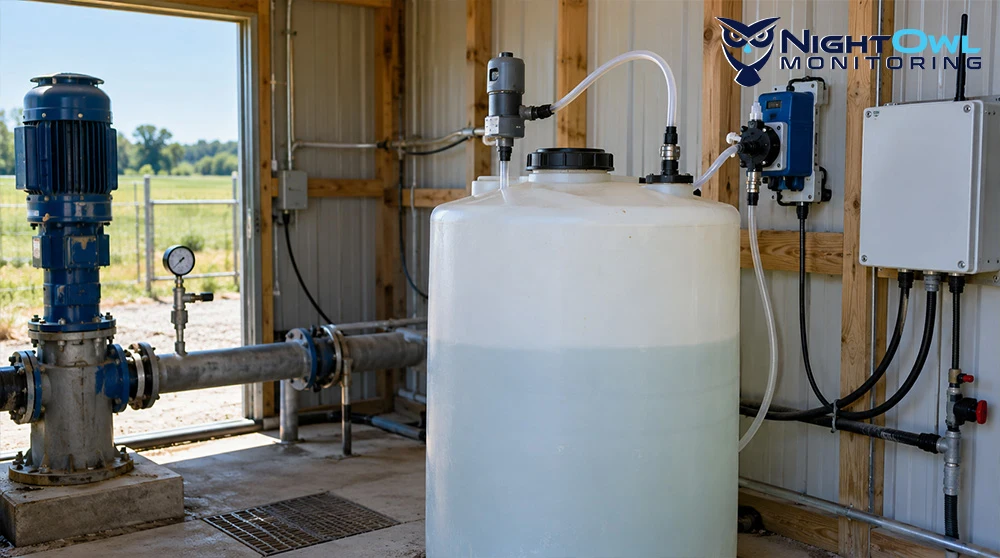
At a water well or small system, this rarely stands alone. Chemical feed tanks sit next to the pump house, wired into the same chemical feed pump or injection system that doses chlorine into the discharge line. Monitoring that tank only makes sense as part of monitoring the whole site: water level in the well, pump amperage, discharge pressure, and the feed tank all failing or draining together tells a different story than the feed tank alone.
Why Well Operators and Drillers Need This, Not Just Industrial Plants
Large chemical plants have process engineers and dedicated inventory teams. A rural water system serving 200 connections has one operator covering wells, tanks, pumps, and now a disinfection system, often across several unmanned sites separated by miles.
That operator faces a specific risk industrial monitoring guides don’t address: a chlorine feed tank running dry doesn’t just interrupt production, it can mean water leaving the system without required disinfection. Depending on the state and system type, that can trigger a boil water notice, mandatory customer notification, and a report to the primacy agency the same category of compliance exposure covered in our guide to EPA drinking water rules for small systems.
For a well driller managing chemical feed systems as part of a service contract, an empty feed tank discovered during a routine visit is also a liability question: how long was it empty, and what left the site during that window?
How Chemical Feed Tank Monitoring Works
Chemical feed tank monitoring uses a level sensor to measure how much treatment chemical remains in the tank and transmit that information to a remote monitoring platform. Instead of relying on manual tank checks, operators can view tank levels, consumption trends and alerts remotely.
1. Sensor Measures Tank Level
A level sensor measures the amount of chemical remaining in the feed tank. Depending on the system and sensor configuration, the measurement can be reported as tank level, percentage full or estimated volume.
2. Cellular Telemetry Sends the Reading
The monitoring device transmits the tank-level data through cellular connectivity, allowing information from an unmanned well or pump site to reach the monitoring platform without requiring an operator to be physically present.
3. Cloud Dashboard Stores the Data
The readings are collected in a cloud-based dashboard where operators can review current tank status, historical levels and consumption trends alongside other monitored well-site conditions.
4. Operators Monitor Level and Consumption Trends
Instead of seeing only whether a tank is full or empty, operators can monitor how quickly the chemical is being consumed. A changing consumption pattern can help identify when a refill may be needed or when unusual usage deserves investigation.
5. Alerts Trigger at Configured Thresholds
When the tank reaches a configured low-level threshold or the system detects an unusual consumption pattern, the monitoring platform can notify the appropriate operator or service team.
6. Operators Schedule Refill or Service
With advance visibility into tank levels and consumption, operators can plan a refill, service visit or further investigation before the chemical supply becomes an urgent problem.
Benefits of Chemical Feed Tank Monitoring
Remote chemical tank visibility helps operators identify low levels before they become urgent, monitor consumption trends, reduce unnecessary site visits and coordinate refills or service more efficiently. When chemical tank data is viewed alongside well level, pump and pressure information, operators can understand more of what is happening across the site from one monitoring platform.
How NightOwl Monitors Chemical Feed Tanks Alongside the Well
NightOwl’s platform already tracks water level in the well, storage and chemical tank levels, pump amperage and voltage, discharge pressure, and pump house conditions as standard sensor points. Chemical tank monitoring uses the same radar-based NightOwl-TLM sensor already deployed for storage tank level tracking, or the multi-sensor NightOwl-Ultra where the feed tank is one input among several at a more complex site.
NightOwl-TLM for a single feed tank
The TLM is a battery-powered radar level sensor rated for hazardous and corrosive locations (Cl1 Div1 Zone0 certified, IP68 housing), which matters because a chemical feed tank sits in exactly the kind of environment that certification exists for. It reports level hourly and publishes daily, which is enough resolution to catch a tank draining toward empty over days, though not a sudden leak within the hour.
NightOwl-Ultra for feed tank plus well
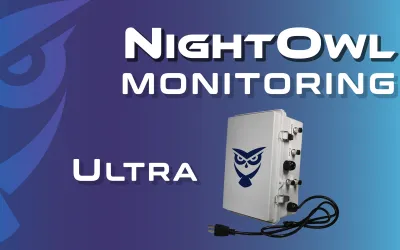
Where the feed tank shares a panel with well pump monitoring, pressure sensors, and power monitoring, the Ultra logs on a 5-minute default interval and can trigger a relay-based alert or shutdown alongside its chemical tank reading. This is the configuration most drillers use when a service contract covers the whole site rather than a standalone tank.
What the dashboard shows
Current volume and percent full, consumption trend, estimated days to empty, and alarm history sit next to the well’s water level, pump runtime, and pressure readings on one screen. An operator watching for a well problem sees the feed tank status without switching systems.
Setting Up Chemical Tank Alerts That Match Your Site
Generic low-level alarms produce false alerts that get ignored. NightOwl customers who run this well set thresholds based on the specific tank’s fill volume and the site’s average dosing rate over two to four weeks of baseline data, the same approach we recommend for setting pump amperage baselines in our guide on well pump remote diagnostics.
A useful threshold answers a specific question: given current consumption trend, how many days until this tank needs a refill or delivery, and is that inside or outside your normal service route timing? NightOwl alerts on percent-full thresholds and consumption-rate anomalies, so an unexpectedly fast draw which can indicate a stuck injector pump running continuously, not just normal use triggers a different alert than a routine low-level warning.
Compliance Reporting for Chemical Dosing
For municipal and small system operators, automated timestamped records of chemical tank levels support the same audit trail requirements covered in our guide to EPA PFAS compliance for small water systems: proof that dosing was maintained, when a tank was refilled, and whether any gap in disinfection chemical availability occurred. NightOwl’s automated monthly reporting compiles this alongside pump and pressure data rather than requiring a separate chemical-specific compliance log.
Chemical Feed Tank Monitoring for Drilling Contractors
For drilling and pump service companies already offering monitoring as a recurring revenue service, adding chemical feed tank visibility to an existing well monitoring contract is a natural extension rather than a new product line. A contractor monitoring a rural system’s well, pump, and pressure tank can add the site’s chlorine feed tank to the same dashboard and the same monthly service fee, the kind of bundled offering described in our guide to recurring revenue for drilling companies.
This matters commercially too: a contractor who can show a municipal customer that chemical dosing, water level, and pump health are all visible from one system has a stronger renewal case than one offering tank monitoring as a separate add-on from a different vendor.
Choosing the Right NightOwl System for a Feed Tank Application
| Site | TypeRecommended System | Why |
| Single chlorine feed tank, no other sensors | NightOwl-TLM | Battery-powered, hazardous-location rated, simplest install |
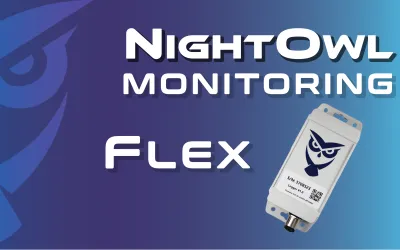
| Feed tank plus well water level and pump monitoring | NightOwl-Flex | Multi-sensor Modbus support, monitoring only, lower cost |
| Feed tank plus pump control, relay-based shutdown, compliance reporting | NightOwl-Ultra | Analog and digital inputs, relay outputs, automated reporting |
Our full comparison of NightOwl Flex vs Ultra vs TLM covers the decision in more depth for sites combining multiple sensor types.
Frequently Asked Questions
What is chemical feed tank monitoring for a water well?
It is a remote sensor system that tracks the level of a treatment chemical such as chlorine at a well or pump site, reporting current volume and low-level alerts to a cloud dashboard alongside the well’s other monitored conditions.
Can NightOwl monitor a chemical feed tank and a well pump on the same system?
Yes. NightOwl-Flex and NightOwl-Ultra both support monitoring a chemical or storage tank level alongside well water level, pump amperage, and pressure sensors on one unit and one dashboard.
How often does NightOwl report chemical tank levels?
The NightOwl-TLM reports hourly readings published daily. NightOwl-Ultra logs on a 5-minute default interval when the feed tank shares a panel with other site sensors requiring faster response.
Does chemical tank monitoring help with compliance reporting?
Yes. Automated, timestamped tank level records support the documentation small water systems need to demonstrate consistent disinfection and respond to primacy agency requests, reducing reliance on manual logs.
Is this only for municipal water systems?
No. Rural water systems, HOAs, RV parks, and well drilling contractors managing chemical dosing as part of a service contract all use the same monitoring approach, scaled to the size of the system.
How does this differ from monitoring an industrial chemical storage tank?
Industrial chemical tank monitoring for manufacturing or processing facilities typically involves different chemical types, larger storage volumes, and integration with ERP or supply-chain systems. Feed tank monitoring at a water well focuses specifically on disinfection and treatment chemical dosing tied to well and pump performance, which is what NightOwl’s platform is built for.
The Bottom Line
A chemical feed tank running dry at a well site is a water quality and compliance risk, not just an inventory inconvenience. NightOwl Monitoring tracks chemical tank levels using the same NightOwl-TLM and NightOwl-Ultra hardware already deployed for well water level and pump monitoring, giving drillers, municipalities, and rural system operators one dashboard for the whole site instead of a standalone tank gauge. For systems already running NightOwl on their well and pump, adding the feed tank is a configuration change, not a new system.
If you’re managing chemical dosing at a well site without remote visibility, contact NightOwl Monitoring to see how a feed tank sensor fits into your existing monitoring setup.
Partner With NightOwl for Remote Well Monitoring
Well drillers and pump service companies can add remote chemical feed tank monitoring to their existing monitoring services. NightOwl helps contractors give customers visibility into well levels, pump conditions, pressure and chemical tank status from one monitoring platform.