
 ChatGPT
 Perplexity
 Claude
 Gemini
 Grok
Grok
Artesian well water is groundwater stored under natural pressure between two impermeable layers, like clay or shale. When a well taps into that confined aquifer, water rises on its own, sometimes flowing to the surface without a pump. Artesian water is not a different type of water. It is the same groundwater, defined by how it is stored and delivered under pressure.
This guide explains how artesian wells work, how they differ from springs and regular wells, whether the water is safe to drink, and what to monitor on an artesian system.
Key Takeaways:
- Artesian water is groundwater under natural pressure in a confined aquifer
- It can flow to the surface without a pump
- Artesian water is not automatically cleaner or safer than other well water
- Testing is the only way to confirm water quality
- Artesian systems still need monitoring for flow, pressure, and tank levels
How Does an Artesian Well Work?
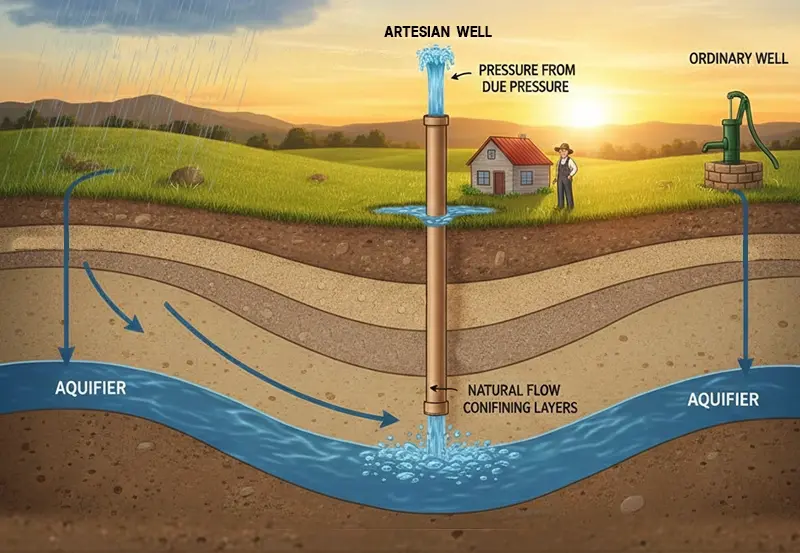
Think of an artesian aquifer like a water-filled layer sandwiched between “tight” layers. Rain and snowmelt can recharge the aquifer at higher elevations. As water moves into the confined layer, it becomes pressurized like water in a hose with the nozzle partially closed.
When you drill a well into that confined zone:
- The well intersects the pressurized aquifer.
- Water rises in the well casing to a level called the potentiometric surface.
- If that rising water level is above ground surface, you get a flowing artesian well.
What Is an Artesian Spring? (Artesian Springs Explained)
An artesian spring happens when the pressurized groundwater finds a natural pathway to the surface through fractures, faults, or low points in the landscape without drilling.
In plain terms:
- A spring is a natural outlet.
- A well is a drilled outlet.
Artesian Well vs Spring: What’s the Difference?
This is one of the most searched questions: is artesian water the same as spring water?
| Factor | Artesian Well | Spring |
|---|---|---|
| Access point | Drilled well | Natural outlet |
| Pressure source | Confined aquifer | Gravity or confined aquifer |
| Flow control | Controlled by wellhead | Natural flow |
| Water quality | Depends on aquifer | Depends on aquifer |
| Testing required | Yes | Yes |
Here is the clean answer:
- Spring water comes from a spring, which is a natural discharge point.
- Artesian water is defined by pressure and confinement, usually accessed by a well, though artesian conditions can feed a spring.
Both can overlap only if the spring is fed by a pressurized confined aquifer. Otherwise, they are different concepts.
Where Does Artesian Water Come From?
It typically recharges from precipitation (rain/snow) that infiltrates the ground in a recharge area and moves into a confined aquifer.
Some artesian systems are massive. A famous example is the Great Artesian Basin in Australia, one of the largest groundwater basins, spanning multiple regions and supporting communities and ecosystems.
Is Artesian Water Safe to Drink?
Artesian water is not automatically safer than any other well water. The confining layers that create artesian pressure can protect water from surface contamination, but they do not guarantee safety.
Potential contaminants in artesian water:
- Minerals (hardness, iron, manganese)
- Naturally occurring elements like arsenic in some regions
- Microbial contamination if the wellhead is compromised or after flooding
The only way to know is to test. Health agencies recommend testing private wells at least once a year for:
- Coliform bacteria
- Nitrates
- Total dissolved solids (TDS)
- pH
Additional tests may be needed based on local risks. If you want a full breakdown of what to test and how often, see our guide to well water testing.
Is Artesian Water Good for You? Benefits, Health, and Safety
It can be but artesian water is not automatically “better” or “cleaner.” The water may not be different in itself; what’s different is how it reaches the surface (pressure in a confined aquifer).
Benefits:
People may prefer artesian well water because it can be:
- Consistent in temperature and supply (depending on the aquifer)
- Mineral-influenced in taste (again: geology-dependent)
- Often perceived as “natural artesian water” because it’s groundwater protected by confining layers
But benefits are not universal. Natural well water can contain:
- Minerals (hardness, iron, manganese)
- Naturally occurring elements (like arsenic in some regions)
- Microbial contamination if the wellhead is compromised or after flooding
Is artesian water safe to drink?
The only way to know is to test. Health agencies recommend regular testing for private wells, at least annually, for indicators like coliform bacteria, nitrates, total dissolved solids, and pH (and additional tests based on local risks).
Is artesian water alkaline?
Sometimes. Many brands market “naturally alkaline” artesian water, but pH varies by geology. It’s not guaranteed by the word “artesian”.
Artesian water softener?
If your artesian groundwater is hard (high calcium/magnesium), a water softener can help with scaling. But a softener is not a “catch-all” for safety, contaminants require the right treatment matched to lab results.
Artesian Water vs Regular Well Water
| Factor | Artesian Well | Regular Well |
|---|---|---|
| Source | Confined aquifer | Unconfined aquifer |
| Pressure | Natural, can flow without pump | Requires pump |
| Depth | Usually deeper | Varies |
| Flow | Self-flowing (sometimes) | Pump-driven |
| Water quality | Depends on aquifer | Depends on aquifer |
| Testing | Required | Required |
| Monitoring | Recommended | Recommended |
The main difference is pressure and confinement, not the water itself. Both can produce excellent water. Both need testing and monitoring. If you want to see how a standard well system delivers water to a house, our guide on how does well water work in a house breaks it down step by step.
Why Artesian Systems Still Need Monitoring
Because artesian wells rely on pressure, they can create unique operational risks:
- Overflow risk (if a flowing artesian well is uncontrolled)
- Pressure swings that change flow rate, tank refill cycles, or pump behavior
- Silent leaks (a slow flow increase/decrease can be easy to miss until damage occurs)
- Seasonal recharge changes affecting the potentiometric surface
This is where modern monitoring becomes a practical advantage for well professionals and the customers they serve. If pressure swings lead to pump strain, see our guide to well pump replacement cost to understand what repairs can run.
What to monitor on an artesian well water system
Even if water flows naturally, most real systems still include tanks, valves, and sometimes pumps/boosters. Useful signals include:
- Water flow
- Tank level
- Pressure
- Pump runtime / cycling
- Threshold alerts (high/low level, abnormal flow, unexpected pump activity)
NightOwl’s monitoring approach is built around exactly these real-world needs, tracking the tank levels, pump activity, and water flow, with alerts by app/email/text and a cloud dashboard for trends and reporting. And importantly, NightOwl is designed with water well professionals in mind.
Frequently Asked Questions
What is artesian well water?
Artesian well water is groundwater stored under natural pressure in a confined aquifer between two impermeable layers. When a well taps that aquifer, water rises on its own and sometimes flows to the surface without a pump.
How does an artesian well work?
A confined aquifer is recharged at higher elevations. The water becomes pressurized between impermeable layers. When a well intersects that zone, pressure pushes water up the casing. If the pressure is high enough, water flows at the surface.
Is artesian water the same as spring water?
No. Spring water comes from a natural outlet. Artesian water is defined by pressure and confinement, usually accessed by a well. A spring can be artesian if it is fed by a confined aquifer.
Is artesian water safe to drink?
Artesian water is not automatically safer than any other well water. Testing is the only way to confirm safety. Test at least once a year for bacteria, nitrates, TDS, and pH.
What are the benefits of artesian water?
Artesian water can be consistent in temperature and supply, mineral-influenced in taste, and perceived as natural because of the confining layers. Benefits depend on the aquifer and are not guaranteed.
Is artesian water alkaline?
Sometimes. pH varies by geology. The word artesian does not guarantee alkalinity.
Does an artesian well need a pump?
A flowing artesian well does not need a pump to bring water to the surface. A non-flowing artesian well still needs a pump to deliver water into the home.
How deep is an artesian well?
Depth varies widely. Artesian wells are usually deeper than shallow wells because they must reach a confined aquifer. Typical residential artesian wells range from 100 to 600 feet or more, depending on local geology.
Final Thoughts
Artesian water is groundwater under natural pressure in a confined aquifer. It is not a different type of water, and it is not automatically safer or cleaner. What makes it unique is how it reaches the surface.
If you own an artesian well, a standard well, or a system with tanks, valves, and boosters, the basics stay the same. You need to know your water quality, you need to watch for changes in flow and pressure, and you need to catch small issues before they become expensive repairs. A flowing artesian well can hide problems just as easily as a pump-driven system. Overflow, pressure swings, and silent leaks do not announce themselves.
This is exactly why NightOwl Monitoring exists. Our platform is built for water well professionals and the homeowners they serve. It tracks tank levels, pump activity, water flow, and pressure in real time, with alerts by app, email, or text and a cloud dashboard for trends and reporting. Whether you manage one well or hundreds, NightOwl fits into the way you already work.